
The Rook — Structure and Sovereignty
In a culture that fetishizes the "pivot" and the "disruption," we have undervalued the Rook, the archetype of structural integrity and the unglamorous labor of holding the line.
In the year 216 B.C., on the dusty plains of Cannae, the Roman Republic faced existential annihilation at the hands of Hannibal. While the Carthaginian general employed a "Knight-like" brilliance, a double envelopment that bypassed traditional military logic, the Roman survival in the aftermath was predicated on something entirely different: the castra. The Roman legionary was not merely a soldier; he was a builder of fortresses. Every night, regardless of exhaustion, the legions constructed a square, walled camp. They relied on the straight line, the right angle, and the predictable defense.
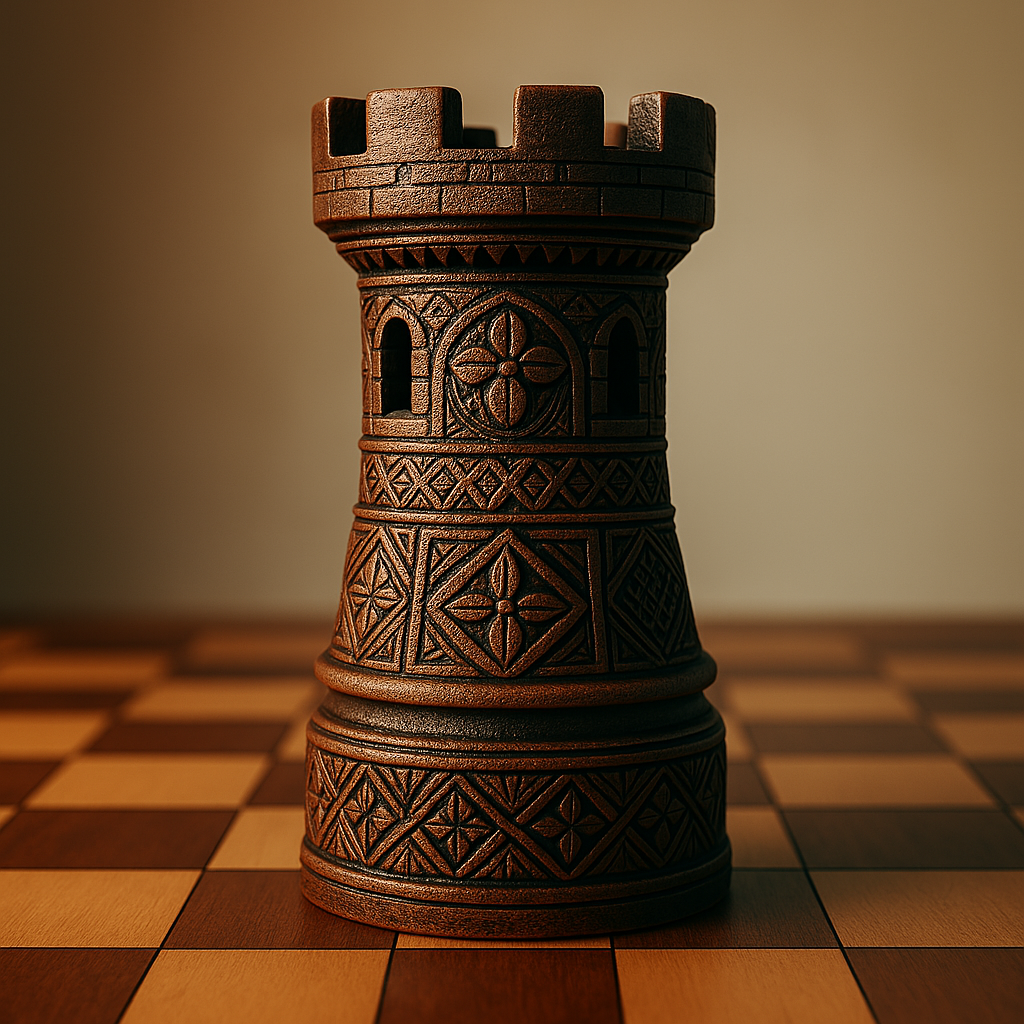
This is the essence of the Rook. In the symbolic taxonomy of power, the Rook is the fortress piece. It does not possess the sweeping, multi-directional grace of the Queen, nor the eccentric, leaping intuition of the Knight. It moves only in ranks and files: straight, long, and uncompromising. Its power is not found in subtlety, but in the terrifying reach of its solidity. The Rook is the embodiment of "Structure," the necessary architecture that ensures a system does not dissolve into the very chaos it seeks to navigate.
The Geometry of the Rank and File
To the modern eye, the Rook’s movement can appear unimaginative. It lacks the "diagonal" vision of the Bishop, which sees the nuances of influence, and the "L-shaped" subversion of the Knight. However, the Rook’s restriction is its strength. By moving only in straight lines, it commands the "long view." It guards the King’s flank and secures the corners of the world.
"Stability is not a lack of movement, but a form of strategic presence. It is the guardrail that makes the rest of the game safe to play."
In any functioning society, the Rook represents the institutionalist. This is the general who understands that a war is won not by the "spectacle" of a charge, but by the integrity of the supply lines. It is the lawmaker who insists on the "straight line" of the rule of law, even when the mob demands a more "erratic" form of justice. The Rook reminds us that stability is not a lack of movement, but a form of strategic presence.
The Burden of the Bastion
There is a particular psychological weight to being the "loyalist." To be the Rook is to be the person who shows up, not because it is exciting, but because it is right. In the workforce, the Rook is the colleague who maintains the foundational systems that allow the "visionaries" to experiment. In the family, it is the parent who provides a consistent, unwavering environment while others chase the horizon of possibility.
This is the ethics of stewardship: the realization that someone must be the anchor if the ship is to survive the storm. Yet, as the Roman centurions eventually discovered, loyalty to structure can carry the seeds of its own obsolescence. The Rook’s strength, its steadfastness, can easily harden into a refusal to acknowledge that the board has changed.
The Shadow of the Wall
Every archetype contains a failure state, and for the Rook, it is "dogmatism." When the desire for order becomes an end in itself, the fortress becomes a prison. History is replete with "Brittle Rooks," institutions that preserved their internal logic long after they had lost their external relevance.
We see this in the courts that enforce the letter of the law while violating its spirit, or in the corporate hierarchies that prioritize policy over people. When the Rook clings too tightly to the "straight line," it becomes unable to pivot when the enemy arrives from a diagonal. The shadow of the Rook is the manager who enforces a manual at the expense of a mission, or the friend who confuses loyalty with a refusal to speak the truth. This is not the strength of the tower; it is the stubbornness of the ruin.
The Necessity of the Immutable
Despite the modern preoccupation with "agility," the Rook remains the indispensable condition for any lasting achievement. We live in an era where institutions are crumbling, not because they are too strong, but because they are too fluid. We have plenty of "Knights" leaping into new ventures and "Queens" exerting tactical pressure, but we are facing a deficit of "Rooks," of people and structures that are simply, reliably there.
"The Rook does not crave recognition. Its reward is the silence of a line that held."
The Rook does not crave recognition. Its reward is the silence of a line that held. Its dignity lies in the quiet force of sovereignty, the knowledge that it is the foundation upon which every other move is built.
The Hidden Fortresses
There are "hidden rooks" in every community: the teachers who return to the same classroom for thirty years, the civil servants who protect the integrity of a process regardless of who is in power, the neighbors who form the steady wall of a support system. You know them not by the noise they make, but by the vacuum they leave behind when they are gone. When the Rook is absent, the whole structure trembles.
The Rook does not win the game through a singular, brilliant stroke. It wins the game by ensuring that the kingdom is still standing when the final move is made.
Next in the Archetype Series: The Pawn, Becoming Through Burden. The Pawn may be small, but he is closest to transformation. His journey is not about protection or power, but about movement: slow, steady, and unglamorous, toward the possibility of becoming something entirely new.
The Sovereignty of the Board: A Complete Inquiry
An exploration of the six governing forces of human ambition, presence, and legacy.
The King | The Stillness of Power On the heavy, silent axis of leadership and the burden of the center.
The Queen | Motion in All Directions On the kinetic imperative and the expansive reach of the matriarch.
The Bishop | Vision in Angles On the oblique perspective and the unseen costs of every move.
The Knight | The Architecture of the Leap On disruption, unorthodox strategy, and bypassing the status quo.
The Rook | The Sovereignty of the Straight Line On structural integrity, the guard, and the walls that endure.
The Pawn | The Long March On the radical potential of persistence and the geometry of transformation.
Return to Crown & Shadow HomeJoin the conversation on Facebook to discuss the shifting geometry of our modern board.

About the Author
Germar is a strategist, storyteller, and student of archetypes. He writes at the intersection of leadership, emotional intelligence, and symbolic power, seeking not to impress, but to illuminate.
His work draws from myth, philosophy, and the quiet disciplines of presence. He believes that true influence begins not with charisma, but with character. You can follow his work at GermarReed.com