
The Queen — Motion in All Directions
If the King is the anchor of institutional stability, the Queen is the engine of its evolution. In a world of shifting borders, her power lies in the mastery of movement and the burden of visibility.
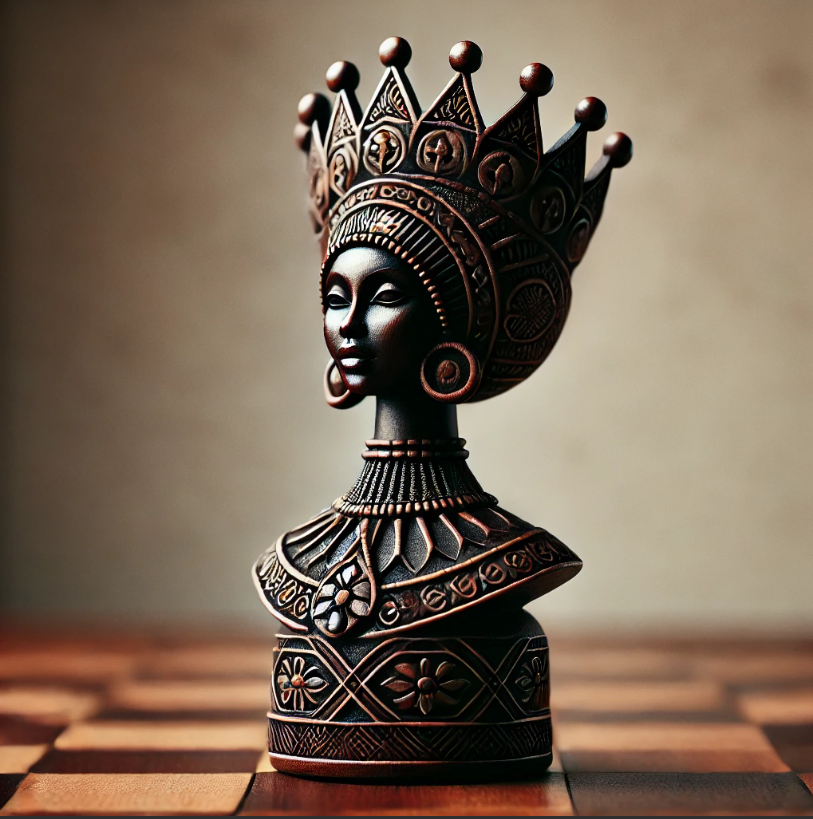
In the rigorous geometry of chess, there is a fundamental asymmetry that mirrors the mechanics of human power. The King is the game’s logical center, a heavy, singular point of gravity that must be protected at all costs. But the King is also, by design, a captive of his own importance. It is the Queen who possesses the "kinetic imperative." She is the only entity on the board capable of crossing vast distances in a single stroke, bridging the gap between defense and offense, between the status quo and the future.
We often mistake the Queen’s role for mere utility, but in the archetypal sense, she represents the principle of presence in motion. If the King is the "axis," the Queen is the "storm." She is the fusion of authority and agility, the force that shapes the board long before the structure begins to fail. In the theater of leadership, she is the difference between a system that merely survives and one that actually functions.
The Architecture of Reach
The Queen’s power is not symbolic; it is profoundly spatial. In any hierarchy or social ecosystem, there is a need for a figure who can transcend boundaries. While the King preserves the center, the Queen pushes the periphery. She dictates the tempo. Without her, the organizational board shrinks into a brittle, defensive posture. With her, it expands into a realm of possibility.
History has always relied on these engines of change. We see this archetype in Elizabeth I, who navigated the precarious religious and political schisms of 16th-century England not by retreating into the palace, but by projecting power across the seas. We see it in Eleanor Roosevelt, who transformed the largely decorative role of the First Lady into a mobile, global office of humanitarian influence.
These figures were not merely "active"; they were strategic. The Queen archetype is defined by reach, the ability to identify a pattern on the far side of the board and move to address it before others have even perceived the threat. Where the King represents the "what" of power, the Queen represents the "how."
The Scrutiny of the Visible
However, the Queen’s velocity comes at a steep psychological and political cost: exposure. To move as the Queen is to live in a state of constant, unblinking visibility. Because she is the most effective instrument on the board, she is also the most scrutinized.
In modern life, this burden is felt acutely by those who carry the "kinetic" weight of an organization (the executives, the innovators, and the cultural catalysts). Her visibility makes her indispensable, but it also makes her a target. The board relies on her reach, yet often fears her autonomy. Unlike the King, who can claim the dignity of silence, the Queen’s power is predicated on her action. If she hesitates, her influence does not merely stall; it evaporates.
"To be the Queen is to move with enough speed to be effective but with enough restraint to avoid being perceived as a threat to the structure you protect."
This creates a particular kind of exhaustion. To be the Queen is to balance force with finesse, to move with enough speed to be effective but with enough restraint to avoid being perceived as a threat to the very structure you protect. It is the "glass cliff" of archetypes: she is given the most room to move, but she has the furthest to fall.
The Shadow of Dispersal
Every archetype contains its own failure state. For the King, it is stagnation; for the Queen, it is "dispersal." Because the Queen can go anywhere, she often tries to go everywhere. Her shadow is overextension, the belief that velocity is a substitute for strategy. When she mistakes her capacity for movement as a mandate to control every square, she risks exhausting her own resources and alienating those she intended to lead.
We see this in the cautionary tale of Catherine de’ Medici, whose attempts to manage the fractured landscape of French religious wars through sheer maneuver and manipulation eventually left her entangled in a web of suspicion. In the modern context, this is the "burnout" of the hyper-competent, the leader who takes on every role, every conflict, and every expectation until their power is spread so thin across the board that it ceases to have any impact at all. The Queen’s downfall is rarely a sudden collapse; it is a gradual thinning of the self.
The Synthesis of Power
In the final analysis, the King and the Queen are not rivals in a zero-sum game of authority; they are the dual lungs of a functioning society. The King provides the "why," the enduring values and structural continuity that give a group its identity. The Queen provides the "how," the tactical brilliance and adaptive movement that allow that identity to survive in a changing world.
"One represents the 'stately,' the other the 'current.' One without the other is incomplete."
One represents the "stately," the other the "current." One without the other is incomplete: a King without a Queen is a statue in a storm; a Queen without a King is a storm without a center. This partnership is the hidden architecture of all successful endeavors. It mirrors the need for both roots and wings, for both the anchor and the sail.
The Unseen Current
There are, of course, "hidden queens" who occupy no formal throne. They are the individuals who work in the background of movements, organizations, and families, shifting the board through sheer competence and reach. They do not seek the crown, but their movement changes the geometry of the room. You spot them not by their titles, but by the way the patterns of a group shift when they enter or leave.
The Queen does not need to be celebrated to be effective. She only needs to move. And when she does, the game (whether it is played in a palace, a parliament, or a living room) is fundamentally altered.
Next in the Archetype Series: The Bishop, Vision in Angles. Where the Queen covers ground, the Bishop sees what others miss. He does not move straight, but he perceives the diagonals of power, and often, the unseen costs of every decision.
The Sovereignty of the Board: A Complete Inquiry
An exploration of the six governing forces of human ambition, presence, and legacy.
The King | The Stillness of PowerOn the heavy, silent axis of leadership and the burden of the center.
The Queen | Motion in All DirectionsOn the kinetic imperative and the expansive reach of the matriarch.
The Bishop | Vision in AnglesOn the oblique perspective and the unseen costs of every move.
The Knight | The Architecture of the LeapOn disruption, unorthodox strategy, and bypassing the status quo.
The Rook | The Sovereignty of the Straight LineOn structural integrity, the guard, and the walls that endure.
The Pawn | The Long MarchOn the radical potential of persistence and the geometry of transformation.
Return to Crown & Shadow HomeJoin the conversation on Facebook to discuss the shifting geometry of our modern board.

About the Author
Germar is a strategist, storyteller, and student of archetypes. He writes at the intersection of leadership, emotional intelligence, and symbolic power, seeking not to impress, but to illuminate.
His work draws from myth, philosophy, and the quiet disciplines of presence. He believes that true influence begins not with charisma, but with character. You can follow his work at GermarReed.com