
In the slow, unidirectional movement of the board’s humblest figure lies the only path to a radical metamorphosis.
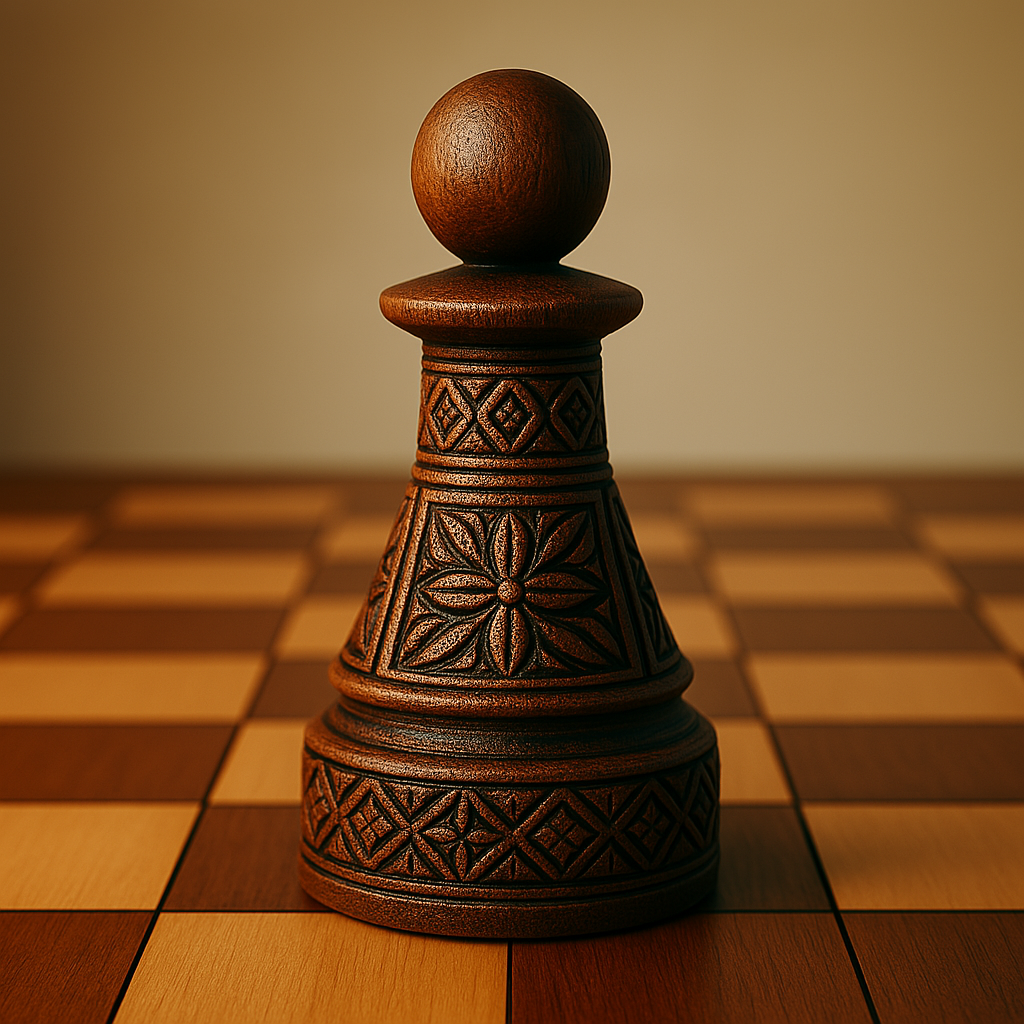
In our obsession with the "Kinetic Imperative" of the Queen and the "Axis" of the King, we have overlooked the only piece on the board capable of a total ontological shift. In the winter of 1749, inside the smoky, intellectual fervor of the Café de la Régence in Paris, a young man named François-André Danican Philidor was busy dismantling the aristocratic assumptions of European strategy.
At the time, chess was viewed as a game of "noble" maneuvers: heroic dashes by the Queen, clever leaps by the Knight, and the heavy, structural shielding provided by the Rook. The pawns were seen as mere clutter, the "cannon fodder" of the board, to be cleared away as quickly as possible to make room for the real drama. Philidor, however, published a treatise that would scandalize the salons of the Enlightenment: L'Analyze du jeu des Échecs. In it, he penned the sentence that serves as the foundational text of modern strategy: "Les pions sont l’âme du jeu" (Pawns are the soul of the game).
"Les pions sont l’âme du jeu: Pawns are the soul of the game."
To the casual observer, this sounds like a populist platitude. But Philidor was not merely being sentimental. He had identified a profound structural truth that extends far beyond the sixty-four squares of the board. He recognized that while the "noble" pieces are defined by what they are, the Pawn is defined by what it might become. In a world increasingly dominated by fixed identities and institutional stasis, the archetype of the Pawn offers us the only viable model for genuine, fundamental transformation.
The Arrow of Time and the Psychological Weight of No Retreat
The most striking feature of the Pawn is its absolute prohibition from looking backward. In the entire taxonomy of power, both on the board and in the halls of human governance, the Pawn is the only entity that cannot retreat. The King can fall back into his castle; the Queen can flee across the board to safety; even the Bishop and Knight can retreat to their starting squares to regroup. The Pawn, however, is a creature of the "Long March." Every move it makes is an irreversible commitment to the future.
In the language of sociology, this unidirectional existence is the defining characteristic of the "subaltern" classes: the entry-level employee, the manual laborer, the migrant. For these individuals, life is not a series of maneuvers; it is a series of commitments. When a migrant crosses a border, or when a worker invests twenty years into a single trade, they are moving a pawn forward. There is no "undo" button. There is no strategic retreat to the safety of a previous life.
This lack of a backward gear is often mistaken for a lack of agency. Because the Pawn cannot turn back, we view its movement as a forced march. But there is a hidden, psychological power in this limitation. By being denied the luxury of retreat, the Pawn is the only piece that truly participates in the "arrow of time." It is the only piece that accumulates a history. While the Bishop bounces between diagonals in a cycle of eternal recurrence, the Pawn is always closer to its destination than it was the move before. It embodies the "sunk cost" not as a fallacy, but as a fuel.
The Ontological Trap of the Elite
To understand the Pawn’s power, one must first understand the specific kind of paralysis that affects the elite. In chess, as in life, the "noble" pieces are trapped by their own excellence. A Queen is born a Queen and will die a Queen. Her power is vast, she can traverse the board in a single stroke, commanding multiple lines of force simultaneously, but her nature is static. She is an ossified identity.
In our corporate and political cultures, we see this in the "C-Suite" executive or the legacy politician. They have immense reach, but their range of movement is strictly governed by the very expectations and structures that gave them power. A CEO cannot suddenly decide to be a creative disruptor without collapsing the stock price; a politician cannot move against their base without losing their seat. They are highly functional, but they are incapable of evolution.
"The noble pieces represent 'The Being.' The Pawn, however, represents 'The Becoming.' It is the only piece on the board capable of a total ontological shift."
The journey to the eighth rank, the "promotion," is the only meritocratic act in the game. It is a slow, unglamorous grind through a field of predators, where every step is a gamble against invisibility. But if the Pawn survives the march, it can transcend its birthright. It can become a Queen. This is not merely an upgrade in rank; it is a fundamental rewriting of its own physical laws. It is the janitor who founds the company; it is the revolutionary who rewrites the constitution. The elite pieces fear the Pawn’s promotion because it introduces a new, unpredictable "High Piece" into a system that thought it had mapped all the variables.
The Mechanics of the Grind: The Power of the Pawn Chain
While individual heroism is the currency of the Knight and the Queen, the Pawn operates through the "chain." In chess strategy, a pawn chain is a diagonal line of pawns that protect each other. If you attack the head of the chain, the base supports it. If you attack the base, the entire structure must be re-evaluated.
This is the archetype of collective action. History is not, despite the "Great Man" theories of the 19th century, a series of dashes by brilliant individuals. It is a slow, grinding advance of collective structures. The labor movements of the early 20th century, the civil rights marches of the 1960s, and the digital grassroots movements of today all operate on the logic of the pawn chain.
The strength of the chain lies in its anonymity. A Queen is a target because she is unique. A Pawn is a threat because it is part of a formation. When the "Pawn structure" of a society is healthy, the "noble" pieces feel secure. When the structure begins to shift, when the pawns move in a coordinated, irreversible advance, the entire board begins to tremble.
The Strategic Sacrifice and the Ethics of the Gambit
We must confront the grim reality of the Pawn’s journey: to be the agent of change is to be expendable. In the history of warfare, "pawns" were the vanguard, the first to meet the enemy and the most likely to be left on the field. In the history of capitalism, they are the "essential workers" who are praised in rhetoric but sacrificed in the budget.
In chess, this is the "gambit," the intentional sacrifice of a pawn to gain a positional advantage for the "nobility." This raises a profound ethical question for any society: Is the march toward the eighth rank a genuine path to transformation, or is it a carrot dangled to keep the masses moving forward into the meat grinder?
The Crisis of Mobility: When the Path is Blocked
We are currently living through a crisis of the "eighth rank." Across the developed world, the promise of the Long March (that if you work hard, move forward, and never look back, you will eventually "promote") is beginning to feel like a lie. When a society’s pawns realize that the path to promotion is blocked, they stop moving forward. They become "doubled pawns" or "isolated pawns," strategic liabilities that clog up the board.
This is the source of modern populism and social unrest. It is the sound of the "soul of the game" crying out in frustration. A "pawn break" in chess occurs when a pawn moves forward to challenge an opponent's pawn, forcing the lines to open up. In a sociological sense, we are seeing "pawn breaks" across our political landscape. The grassroots are no longer content to be part of a stable chain that protects the King; they are moving forward to challenge the very structure of the game.
The Sovereignty of Persistence
There is a radical dignity in the Pawn’s movement that we would do well to emulate. It does not ask for special treatment. It does not rely on the "leaps" of intuition that define the Knight, nor the "diagonals" of influence that define the Bishop. It relies solely on the sovereignty of persistence.
To lead as a Pawn is to understand that the most meaningful work is often the most unglamorous: it is the work of showing up, day after day, and moving one square forward. It is the work of holding the line so that others can thrive. It is the work of refusing to retreat, even when the Queen is bearing down on you.
The Soul of the Game
Philidor’s insight remains the most important lesson for any student of power. The "noble" pieces may provide the spectacle, the speed, and the immediate drama of the game, but it is the pawns that provide the meaning. They are the ones who define the space, who bear the history, and who hold the promise of transformation.
"The Pawn is not just a piece to be moved; it is a destiny waiting to be fulfilled."
The board is a mirror of our world. In every organization, in every family, and in every political system, there are those who think they are the Queens, moving with reach and authority, and those who know they are the Pawns, moving with burden and hope. But the Queens should be wary. The King should be humble. Because the "soul of the game" is moving, one square at a time, toward a future that none of the elite pieces can fully anticipate.
Stand. March. The eighth rank is closer than it was yesterday. The board is waiting for you to change it.
Next in the Archetype Series: The Tyranny of the Clock, On the Scarcity of Strategic Time. Chess is not merely a game of space and pieces; it is a battle against the vanishing second. What happens to wisdom when we are forced to play "Blitz" with our lives?
The Sovereignty of the Board: A Complete Inquiry
An exploration of the six governing forces of human ambition, presence, and legacy.
The King | The Stillness of PowerOn the heavy, silent axis of leadership and the burden of the center.
The Queen | Motion in All DirectionsOn the kinetic imperative and the expansive reach of the matriarch.
The Bishop | Vision in AnglesOn the oblique perspective and the unseen costs of every move.
The Knight | The Architecture of the LeapOn disruption, unorthodox strategy, and bypassing the status quo.
The Rook | The Sovereignty of the Straight LineOn structural integrity, the guard, and the walls that endure.
The Pawn | The Long MarchOn the radical potential of persistence and the geometry of transformation.
Return to Crown & Shadow Home Join the conversation on Facebook to discuss the shifting geometry of our modern board.

About the Author
Germar is a strategist, storyteller, and student of archetypes. He writes at the intersection of leadership, emotional intelligence, and symbolic power, seeking not to impress, but to illuminate.
His work draws from myth, philosophy, and the quiet disciplines of presence. He believes that true influence begins not with charisma, but with character. You can follow his work at GermarReed.com