The Knight — Disruption with Precision
In an era defined by linear progress and predictable trajectories, we have lost the art of the “Knight”, the disruptive strategist who moves in the L-shape of human intuition rather than the straight lines of bureaucratic logic.
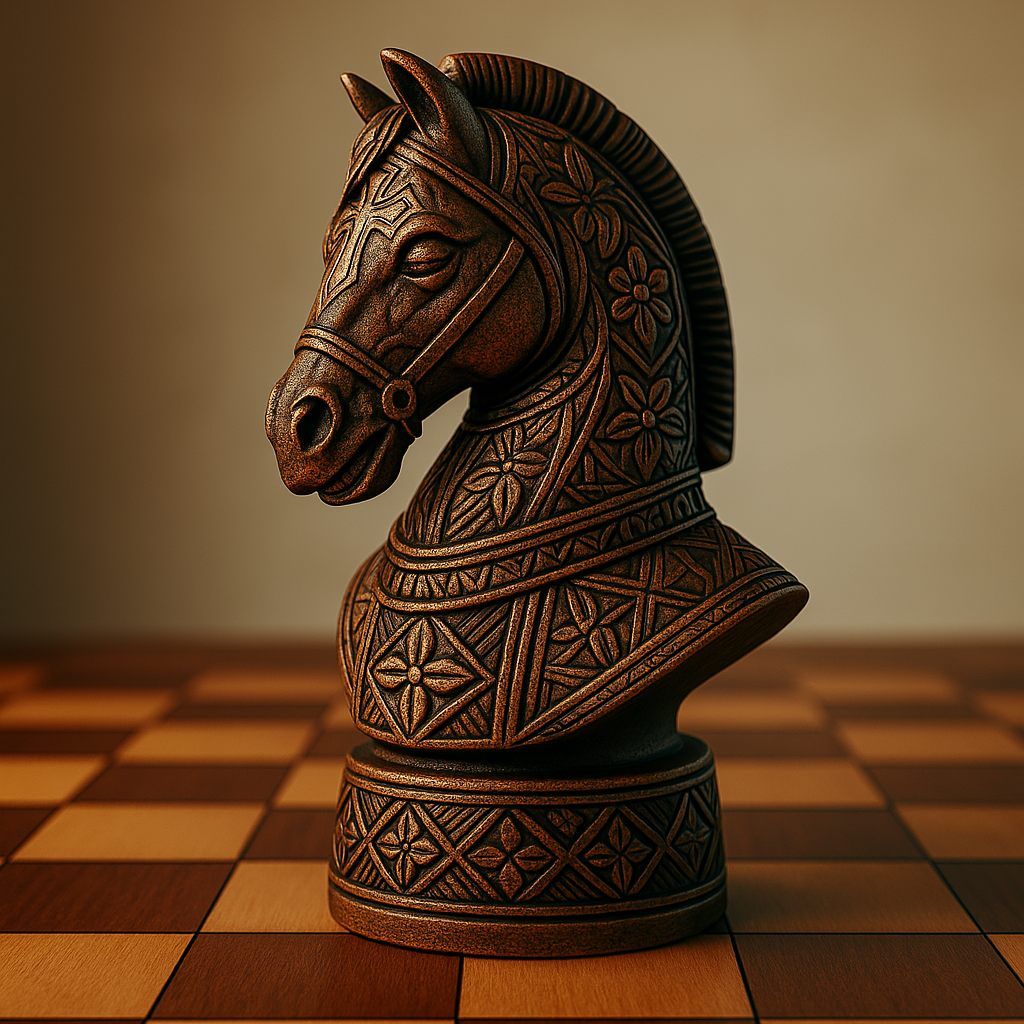
In the rigorous, binary world of the chessboard, every piece is a slave to its own geometry. The Bishops are tethered to their diagonals; the Rooks are bound to the rank and file; even the Queen, for all her terrifying reach, is a creature of straight lines. But the Knight operates in a different dimension. It does not slide; it leaps. It does not follow a path; it creates a destination.
The Knight is the board’s great eccentric. It is the only entity capable of bypassing the physical barriers of the system, leaping over the crowd to strike at a point that was, moments before, mathematically secure. This is the archetype of the "Disruptor" (the individual who realizes that when the lines of power have become too rigid, the only way forward is to move sideways).
The Geometry of the Unconventional
The strength of the Knight is not found in its volume, but in its refusal to comply with the standard physics of the game. In any complex system, be it a political institution, a corporate hierarchy, or a scientific field, there is a natural tendency toward "calcification." Over time, the paths of least resistance are mapped out, and the "rules" of engagement become so predictable that they invite stagnation.
"The Knight is the antidote to this inertia. He does not 'slide' into the existing hierarchy; he leaps over it."
The Knight is the antidote to this inertia. We see this archetype in the figure of Joan of Arc, who appeared at the gates of Orléans not as a traditional military strategist, but as a mystic who bypassed the stagnant chivalric codes of 15th-century warfare. She did not "slide" into the existing hierarchy; she leapt over it. In the modern era, we see it in Steve Jobs, who famously insisted that technology should not follow the linear path of engineering, but the L-shape of artistic intuition. This is "pattern-breaking as purpose." The Knight understands that some defenses are impenetrable to a frontal assault. To win, one must introduce a variable that the system is not programmed to anticipate.
The Pariah’s Burden
However, to move like a Knight is to invite a specific kind of institutional suspicion. Because the Knight’s logic is not linear, it often appears, to those in the center, as irrationality or even betrayal. The L-shape is a "crooked" move in a world that prizes the straight and narrow.
Historically, the Knight is rarely welcomed at the start of the game. They are the outsiders, the dissenters, and the "troublemakers" who question the fundamental "why" of a system’s structure. This is the burden of the unconventional: you are often viewed as a liability until the moment your leap becomes the only thing that saves the kingdom.
In organizations, this is the "internal agitator", the employee who challenges a legacy process or the researcher who pursues a "marginal" theory. They are often marginalized, kept on the edges of the board, because their presence reminds the King and the Queen that the current order is not as absolute as it appears.
The Shadow of the Jolt
Every archetype carries a shadow, and for the Knight, that shadow is "recklessness." When the impulse to disrupt is disconnected from a broader strategy, the Knight becomes an agent of mere chaos. History is littered with "Burned Knights", revolutionaries who successfully dismantled a system but possessed no plan for what to build in its wake.
"A leap is only useful if there is a solid square to land on."
When disruption is pursued for its own sake, the "leap" becomes a fall. We see this in the "disruptive" tech startups that destroy local economies without providing a sustainable alternative, or in the political firebrand who tears down an institution but cannot govern the ruins. The Knight’s downfall is not a lack of courage, but a lack of grounding. Without the stabilizing presence of the King (order) or the Rook (structure), the Knight’s movement is not a strategic strike; it is a seizure.
The Necessity of the Friction
Despite the risks, a system without Knights is a system destined for collapse. When the Queen’s momentum becomes predictable and the Bishop’s vision turns into dogma, the Knight is the only piece capable of breaking the deadlock. The Knight is the reminder that progress is rarely a straight line. It is a series of jolts, a collection of sudden redirections that force us to re-evaluate the board. Without the "leap," we are merely managing decline.
The most powerful Knights today are often those who wear no armor. They are the entrepreneurs who refuse the industry's "best practices," the educators who throw out the curriculum to follow a student's curiosity, and the friends who offer the "disruptive honesty" that cuts through the politeness of a failing relationship. They move differently not because they are chaotic, but because they have perceived a path that the rest of us, blinded by the straight lines of our own lives, have failed to see.
"The board must adjust to the Knight, not the other way around. And in that adjustment, the game evolves."
The board must adjust to the Knight, not the other way around. And in that adjustment, the game evolves.
Next in the Archetype Series: The Rook, Structure and Sovereignty. Where the Knight bends patterns, the Rook builds them. He is the fortress, the guardrail, the steady wall of order that ensures the kingdom does not collapse in the rush of chaos.
The Sovereignty of the Board: A Complete Inquiry
An exploration of the six governing forces of human ambition, presence, and legacy.
The King | The Stillness of Power On the heavy, silent axis of leadership and the burden of the center.
The Queen | Motion in All Directions On the kinetic imperative and the expansive reach of the matriarch.
The Bishop | Vision in Angles On the oblique perspective and the unseen costs of every move.
The Knight | The Architecture of the Leap On disruption, unorthodox strategy, and bypassing the status quo.
The Rook | The Sovereignty of the Straight Line On structural integrity, the guard, and the walls that endure.
The Pawn | The Long March On the radical potential of persistence and the geometry of transformation.
Return to Crown & Shadow Home Join the conversation on Facebook to discuss the shifting geometry of our modern board.

About the Author
Germar is a strategist, storyteller, and student of archetypes. He writes at the intersection of leadership, emotional intelligence, and symbolic power, seeking not to impress, but to illuminate.
His work draws from myth, philosophy, and the quiet disciplines of presence. He believes that true influence begins not with charisma, but with character. You can follow his work at GermarReed.com