
The Prompt Engineer’s Illusion: Why AI Literacy Requires a STEM Foundation
The Prompt Engineer’s Illusion: Why AI Literacy Requires a STEM Foundation
Higher education is rushing to democratize AI access for every major. But operating an algorithm without understanding fundamental logic is the enterprise equivalent of running a Ferrari engine on an uncurated data swamp.
Across American higher education, a quiet reallocation of academic capital is underway. As highlighted in a recent AP News report on higher-ed AI trends, universities from Texas to Harvard are rapidly expanding AI minors, introductory machine learning modules, and prompt-writing workshops for non-computer science majors. Psychology students, music majors, and business undergraduates are rushing to add artificial intelligence credentials to their resumes. University leaders describe this trend as the democratization of tech literacy, comparing basic AI instruction to reading, writing, or arithmetic. Yet while surface-level tool familiarity is rising, incoming enrollment in rigorous, foundational computer science programs has experienced a notable dip. For corporate leadership, this trend introduces a subtle operational vulnerability.
The Architecture Parallel: Garbage In, Garbage Out
In enterprise data strategy, every seasoned executive knows a fundamental truth: no machine learning model, regardless of its parameter count, can overcome a broken data architecture. If you feed high-level analytics algorithms from an uncurated, dirty data lake, your results will suffer from structural degradation. The model will hallucinate, metrics will drift, and strategic decisions based on that telemetry will fail in the market.
Human talent operates under the exact same structural law. Artificial intelligence tools represent the interface layer of modern work. However, core STEM subjects, including mathematics, formal logic, system dynamics, and computer science fundamentals, represent the underlying data structure. When an organization hires individuals who possess interface literacy but lack foundational STEM rigor, it introduces severe architectural risk. An employee who knows how to prompt a generative model to write code or analyze a market, but lacks the mathematical logic to spot an algorithmic anomaly, is an operational liability.
The Risk of "Black Box" Reliance
The danger facing the enterprise is not a shortage of people who can interact with software interfaces. The true danger is the erosion of critical problem decomposition. When software tools do the cognitive heavy lifting under the hood, operators gradually lose the ability to evaluate basic logic, systemic edge cases, and probability distributions. In high-stakes business environments, such as managing autonomous fleet telemetry, financial modeling, or supply chain optimization, blind reliance on machine output inevitably leads to unmitigated risk exposure.
To extract genuine economic value from artificial intelligence, an organization needs professionals who understand system mechanics. They must understand data lineage, statistical confidence intervals, and the physical constraints of the systems they are attempting to optimize. Tool fluency allows a worker to move faster, but fundamental STEM discipline is what ensures they are moving in the right direction.
- Separate Interface Skill from Fundamental Logic: Audit technical candidates on problem decomposition and core quantitative reasoning rather than their familiarity with specific third-party AI software.
- Enforce Architectural Verification: Establish clear protocols requiring human operators to manually verify the logic, data sources, and edge-case behavior of any automated system outputs.
- Pair Domain Specialists with Quantitative Anchors: When deploying non-STEM teams on AI-assisted workflows, embed senior data architects to oversee the mathematical validity of the underlying pipelines.
Building the Durable Enterprise Pipeline
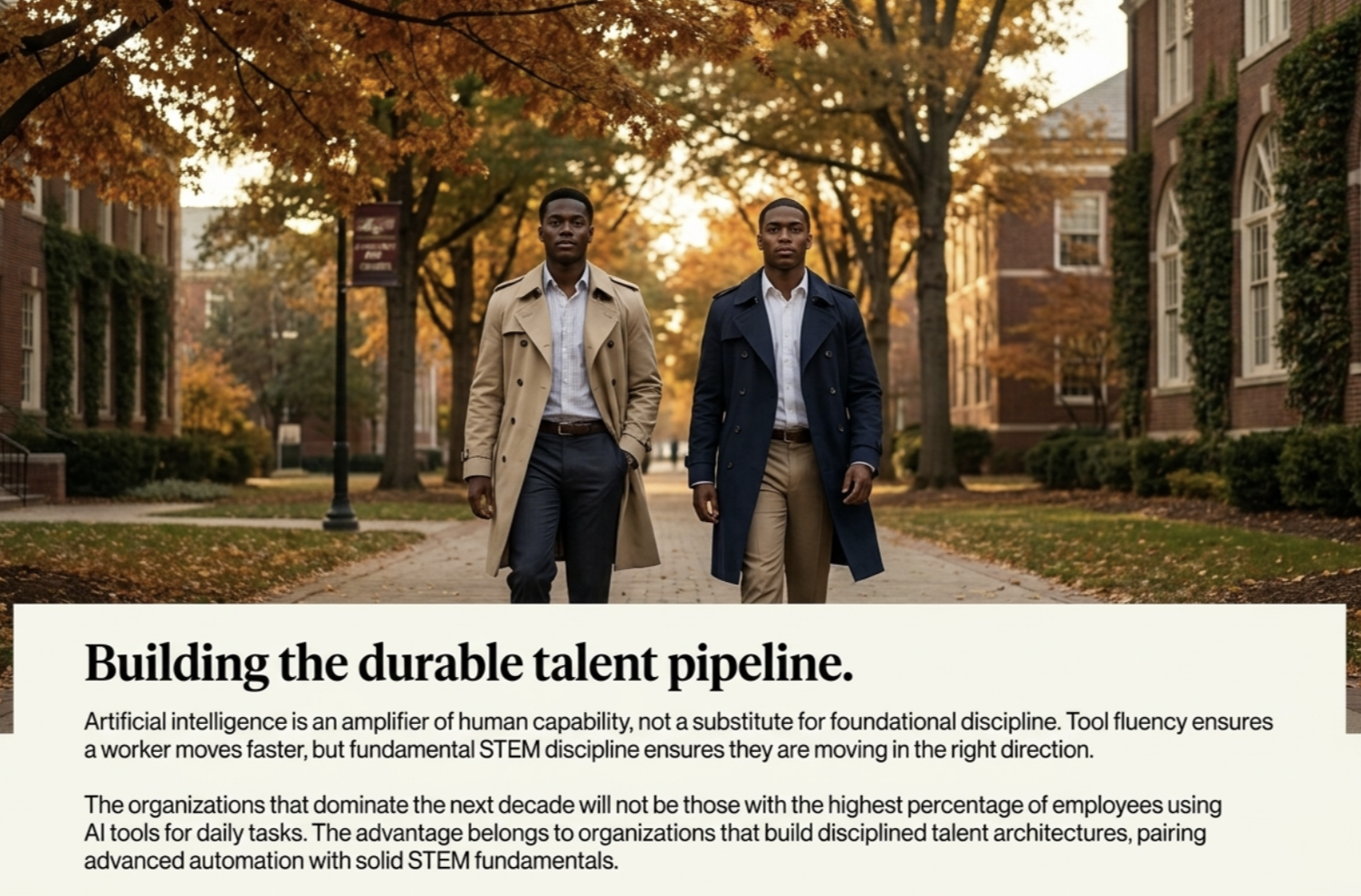
As universities restructure their curriculums to satisfy short-term demand for AI certificates, corporate executives must maintain strategic clarity. Artificial intelligence is an amplifier of human capability, not a substitute for foundational discipline. An operator grounded in mathematics, physics, or traditional software engineering can pick up a new AI interface in an afternoon and use it to solve complex enterprise problems. Conversely, an operator trained solely on prompt interfaces will consistently hit a ceiling when the underlying math fails.
The organizations that dominate the next decade will not be those with the highest percentage of employees using AI tools for daily tasks. The advantage belongs to organizations that build disciplined talent architectures, pairing advanced automation with workforce capabilities rooted in solid STEM fundamentals. Interface tools will continue to evolve and shift overnight. The fundamental laws of logic, data architecture, and mathematics remain permanent.