
The Weight of the Throne: On the Pathological Descent from Stewardship to Survival
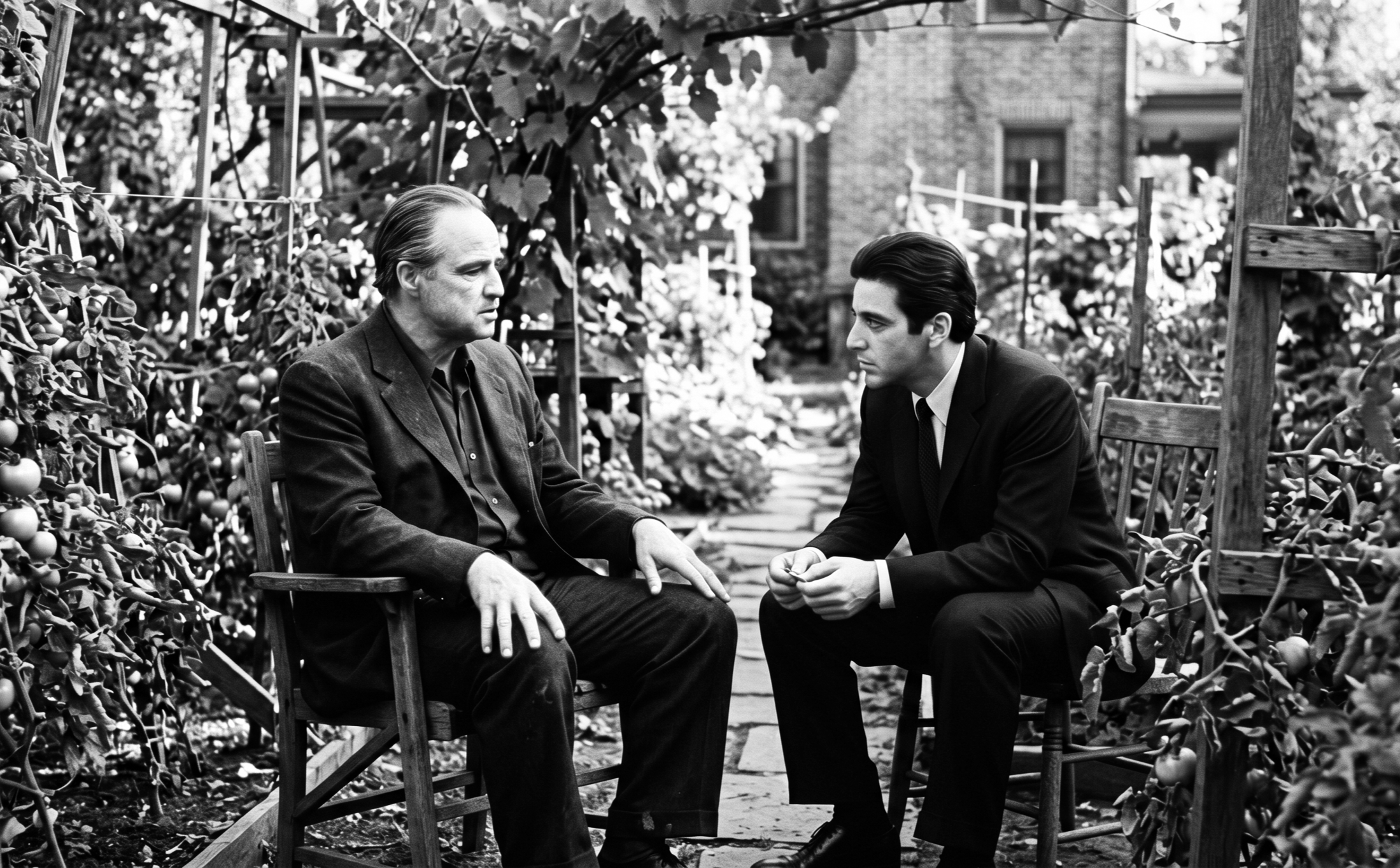
The Weight of the Throne: On the Pathological Descent from Stewardship to Survival
The tragedy of the house of Corleone is not one of violence, but of orientation. When the center of authority ceases to be an anchor for the community and becomes a bunker for the self, the institution does not merely change—it begins to die from within.
The Invisible Axis
In the autumn of 1434, a man named Cosimo de' Medici returned to Florence from exile. He did not arrive with a crown, nor did he occupy a formal office of state. He was a banker, a merchant of silk, and a man of quiet, almost subterranean influence. He understood that in the fragile ecosystem of the Italian city-state, the most enduring power was that which remained invisible. One might observe that Cosimo operated as a "hidden axis," a figure who moved the world by remaining fundamentally still. He was the Pater Patriae—the Father of the Fatherland—not because he commanded the city, but because he underwrote its existence. His wealth and his influence were instruments used to stabilize the collective. For Cosimo, the "house" was the point; the power was merely the mortar between the bricks.
Yet, as the decades bled into centuries, the Medici lineage underwent a curious and devastating transformation. By the late sixteenth century, the subtle, relational stewardship of Cosimo had curdled into the brittle, defensive autocracy of the Grand Duchy. The family no longer used its vast resources to preserve the Florentine project; the Florentine project was systematically cannibalized to maintain the prestige, security, and survival of the family name. The court grew magnificent, but the city became hollow. The anchor had become the storm.
This historical trajectory, the movement from power as a tool of service to power as an end in itself, finds its most haunting modern resonance in the fictional, yet archetypally perfect, transition of the Corleone family. When one examines the arc from Vito to Michael, one is not merely watching a masterclass in cinematic tragedy; one is witnessing the universal pathology of leadership. It is a study of how the "King," whose authority is born of stillness and relational depth, is replaced by a figure of kinetic velocity, and how that kinetic reach, when severed from a moral center, eventually destroys the very house it was meant to guard.
The Turn: From the Axis to the Current
The assertion that Vito Corleone understood power as a service to the family, while Michael saw the family as a servant to power, is not merely a quirk of character. It is a symptom of a much larger crisis in how we value the orientation of authority. In the mid-twentieth century, the Corleone enterprise functioned as a parallel state, a shadow republic that provided the security, justice, and economic stability that the official, hostile government had failed to offer its immigrants.
But this moment is not merely a relic of 1940s New York; it is a mirror held up to the modern institution. Whether in the halls of a multi-national corporation, the administrative offices of a legacy university, or the inner sanctums of political parties, we are watching the same transition. We are moving away from the "Steward", the leader who views their role as the preservation of an enduring sanctuary, and toward the "Manager of Force", the leader who views the organization as a vehicle for their own survival.
"To save the shell of the house by hollowing out its interior is the defining illusion of the modern executive." Crown & Shadow
When an institution enters this latter phase, its leaders no longer ask how they can absorb the shocks of the environment to protect the community; instead, they ask how the community can be deployed as armor to shield the leadership from the shocks of the market. The priority shifts from cultivation to defense, from investment to control. The tragedy of this evolution is that it is almost always initiated by individuals of high competence who believe they are doing what is necessary to survive. They do not realize that to save the shell of the house by hollowing out its interior is the defining illusion of the modern executive.
The Architecture of Stillness: Vito as the Anchor
Vito Corleone, in the taxonomy of human ambition, is the quintessential "King." His power was derived from a profound, almost agonizing refusal to be moved by the tremors of the moment. In the opening scenes of the epic, we do not see him pacing a boardroom or shouting orders into a telephone. We find him in a darkened study, surrounded by shadow and heavy wood, performing the quiet duties of the pater familias. He does not seek out conflict; he waits for the world to come to him.
This stillness is not a sign of passivity; it is the ultimate expression of structural integrity. Like the Roman Republic at its height, Vito’s authority was built on a series of unspoken contracts. He was the "Rook" of his community, a fortress of social obligation. When the undertaker, Amerigo Bonasera, comes to him seeking justice for his brutalized daughter, Vito does not ask for money. To accept currency would be to reduce his authority to a mere transaction, a fleeting exchange that leaves no lasting tie. Instead, he asks for "friendship."
In doing so, Vito binds the undertaker to the house. He understands that a kingdom built on currency is fragile, but a kingdom built on a web of mutual debt, respect, and shared history is virtually indestructible. Aristotle, in his Nicomachean Ethics, distinguished between the friendship of utility and the friendship of virtue. While Vito’s networks were certainly useful, they mimicked the virtues of loyalty and mutual protection, creating an organic social tissue that held the community together.
For Vito, power was a burden of the center. It was the duty to be the rock against which the waves continually break, as Marcus Aurelius once wrote in his private journals on the frozen banks of the Danube. His refusal to enter the narcotics trade was not a matter of Victorian prudishness; it was a strategic assessment of the long-term, non-linear costs. He saw that the "Bishop’s" perspective, the moral standing, the political alliances, and the social legitimacy of the family, would be compromised if they became associated with a substance that degraded the very people they claimed to protect.
Vito chose the stillness of the garden over the rapid velocity of the drug market because he understood that once a King begins to move like a mercenary, he is no longer a King. His power was domestic, rooted in the soil of Little Italy, nourished by the specific, personal knowledge of the people he patronized. He was an anchor, and an anchor only works if it remains embedded in the mud.
The Kinetic Imperative: Michael’s Descent
When Michael Corleone assumes the seat of authority, the nature of the Corleone atmosphere undergoes a radical, chilling shift. Michael is a child of the "Long March," a soldier who has been promoted through the trauma of war and the immediate, visceral exigencies of survival. But in his promotion, he does not adopt the heavy, relational stillness of his father. Instead, he becomes the "Queen", the most powerful, most visible, and most kinetic entity on the board.
Michael’s power is defined by reach. He immediately begins to displace the family, moving them from the old-world, relational structures of New York to the barren sands of Nevada and the crumbling, colonial elegance of Havana. He is the engine of evolution, a strategist who can identify threats across vast distances and move to eliminate them before they manifest. One might observe that Michael is the disruptor par excellence. He treats the traditional, legacy codes of the Five Families as calcified relics to be bypassed. He is the Knight who leaps over the crowd, ignoring the established protocol of the commission to strike directly at the heart of his enemies.
"The tragedy of the kinetic leader is that they mistake the expansion of their reach for the security of their house." Crown & Shadow
However, the tragedy of the kinetic leader is that they mistake the expansion of their reach for the security of their house. Because Michael lacks the internal stillness of his father, he begins to view every other piece on the board as a potential threat to his velocity. In Michael’s world, there are no "Rooks" to guard the walls, only liabilities to be cleared. He systematically dismantles the very infrastructure that made the family safe.
First, he marginalizes the "Bishops", the advisors of oblique vision and conscience. Tom Hagen, the adoptive brother who served as the bridge between Vito’s empathy and the cold realities of the street, is stripped of his role as consigliere. Michael tells him he is "not a wartime consigliere," replacing his nuanced, long-term strategic vision with a narrow, immediate focus on administrative efficiency.
Next, Michael destroys his "Rooks", the loyal caporegimes, Clemenza and Tessio, who had spent decades holding the physical line in New York. He views their local loyalties as a threat to his centralized control. Finally, he executes his brother, Fredo. In this act, the pathology of survival reaches its logical, devastating conclusion. The family, which was the entire purpose of the enterprise, has become a threat to the power that was meant to protect it.
By clearing the board of his own pieces, Michael believes he has achieved total security. In reality, he has achieved only total isolation. He has achieved the absolute visibility of the Queen, yet he has lost the detached, sovereign perspective required to see that a throne sitting in a wasteland is no throne at all.
The Steelman: The Myth of Necessity
One must, in the interest of intellectual rigor, present the strongest possible version of the opposing argument. It is common for contemporary analysts and defenders of Michael’s strategy to argue that he had no choice. The world of Vito Corleone, they argue, was an anachronism. The deep history of early twentieth-century immigration, with its tight-knit neighborhoods and personal loyalties, was being swept away by a more ruthless, corporate, and national era.
In this view, the rising tide of the narcotics trade was not something that could be avoided or negotiated; it was an industrial wave that would have crushed any local empire that refused to ride it. If Michael had remained in the garden, playing the role of the benevolent patron, the Corleone family would have been systematically liquidated by younger, more aggressive syndicates who had no respect for the "unspoken contract."
Furthermore, this argument suggests that Michael’s move to Nevada was a brilliant, necessary pivot to legitimacy. By transitioning from street rackets to casino gambling, he was moving the family’s capital from the shadow economy into the legal, corporate mainstream. The violence he deployed was not pathological, but rather the temporary, concentrated force required to execute a clean break from the past. He was, in essence, a modernizer—a CEO restructuring a legacy firm to survive in a globalized market.
"To argue that one must destroy the soul of an institution to save its shell is the ultimate failure of leadership." Crown & Shadow
Yet, this pragmatism is a mask for a much deeper institutional failure. To argue that one must destroy the soul of an institution to save its shell is the ultimate failure of stewardship. It is the same self-defeating logic used by modern corporations that hollow out their research, development, and customer service departments to meet quarterly earnings, or by political institutions that betray their founding principles to secure a temporary electoral majority. They have saved the brand, but they have forgotten why the brand was created.
Vito Corleone’s power was enduring because it was rooted in the human need for sanctuary, for a paternal figure who would stand between the individual and a hostile world. Michael’s power was ephemeral because it was rooted in the fear of loss. He did not save the family; he merely ensured that its corpse would be housed in a more expensive mausoleum.
The Pathological Metamorphosis of Ritual
The shift from serving the house to making the house serve the center is always accompanied by a change in the nature of ritual. In any human community, rituals are the mechanisms through which values are transmitted, legacy is preserved, and the collective soul is nourished. Under the Steward, these rituals are communal, heavy, and deeply connected to the life of the participants. Under the Manager of Force, they become performative, sterile, and transactional.
Vito Corleone’s life was framed by the organic, chaotic rituals of the community. We see this in the grand wedding of his daughter, Connie. The event is hot, loud, and dusty. It is filled with children running through the grass, old women singing traditional songs, and the patriarch himself dancing with his daughter. It is a ritual of integration. Vito is accessible; he sits in his study, but the door is open, and the boundary between the private family and the public community is porous.
Even his death is a ritual of the soil. He collapses in the tomato garden, playing with his grandson, surrounded by the green vines of his own planting. His end is natural, integrated into the cycle of life and generation.
"Vito was an anchor, and his rituals integrated the family into the world. Michael was a scalpel, and his rituals severed the family from it." Crown & Shadow
Michael’s rituals, by contrast, are exercises in absolute, sterile control. The defining sequence of his life is the baptism of his nephew, interspersed with the simultaneous execution of his rivals. This is a ritual of disintegration. While Michael stands in the cold, stone silence of the church, falsely promising to renounce Satan and all his works, his foot soldiers are carrying out a series of highly coordinated, clinical murders.
The ritual of the sacrament is not an expression of faith, but a cover for a slaughter. It is a clean break, executed with the cold mathematics of an balance sheet.
We see this sterility again in Michael’s home in Lake Tahoe. Unlike the warm, cluttered New York home, the Tahoe estate is a fortress of glass, steel, and stone, patrolled by armed guards and surrounded by high chain-link fences. It is a place of permanent winter. There are no children playing on the lawn, no old songs being sung. The family is no longer a community; it is an audience to Michael’s paranoia.
A Lens for the Modern Ruin
The tragedy of the Corleones offers a vital lens for navigating the modern landscape of authority. We are currently obsessed with the kinetic imperative. We celebrate the leaders who move fast, who disrupt the status quo, and who possess the sweeping reach of the Queen. We have built an entire economic and social culture that rewards the hyper-mobile manager who can pivot daily to avoid the perceived threat of irrelevance.
But in our rush to celebrate the disruptors, we have forgotten the value of the fixed point. We have forgotten that the goal of power is not to expand the reach of the center, but to ensure the stability of the periphery. We are facing a devastating deficit of Vitos, and a pathological surplus of Michaels.
"If we sacrifice the garden for the sake of the fortress, we will eventually find that we have nowhere left to live." Crown & Shadow
True stewardship requires the courage to remain still. It requires the leader to recognize that they are not the authors of the game, but merely the caretakers of the board. They must be willing to absorb the complexities and pressures of their moment so that those who come after them, the unglamorous, slow-moving pawns of history, can continue their long, steady march toward their own quiet transformations.
If we continue to believe that the collective must be sacrificed to preserve the power of the center, we will find ourselves, like Michael in the final frame of his life, sitting alone in a courtyard. The skies will be gray, the family will be gone, and we will be left to watch the dead leaves fall around a throne that has become our prison. If we sacrifice the garden for the sake of the fortress, we will eventually find that we have nowhere left to live.