
Stony the Road We Trod
Stony the Road We Trod
A reminder to those who stand at the threshold of a new age: we were forged in the fire for such a time as this, carrying a structural strength that only falters when we lose the memory of the long march that brought us here.
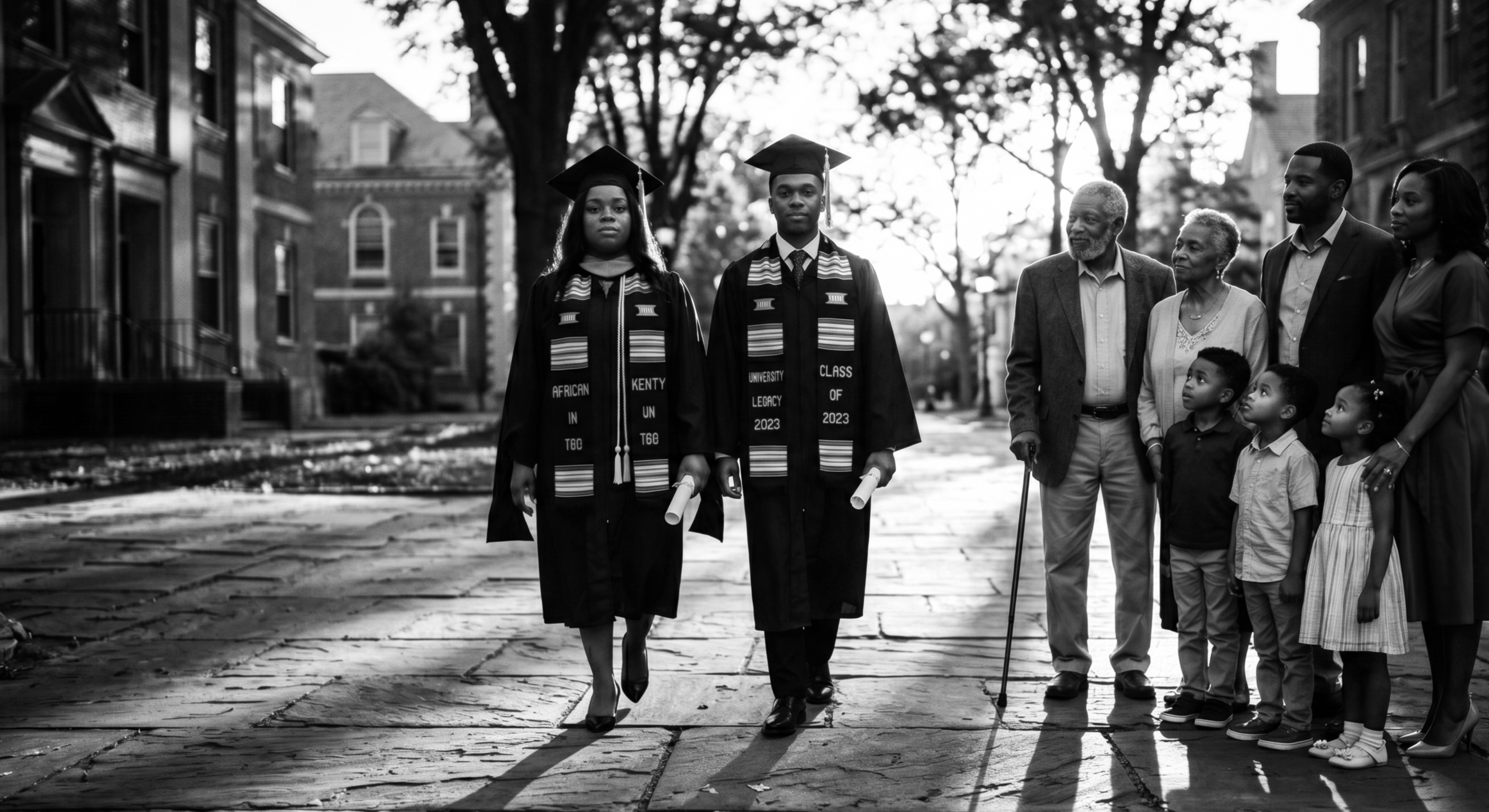
Across the landscape of the American republic this May, a specific and heavy atmosphere precedes the processional. From the sun-drenched quads of the South to the storied, stone-clad enclosures of the North, thousands of Black graduates are adjusting their mortarboards and smoothing the creases of their academic regalia. They stand at a threshold that feels, for the first time in several decades, authentically precarious.
The economic tremors of 2026 have produced a pervasive American vertigo. A nation built on the promise of infinite upward mobility is suddenly grappling with the stasis of high interest, the contraction of the middle-class dream, and the unsettling realization that the clear paths to prosperity have been diverted. For many in the broader culture, the climate is one of profound, unmapped anxiety. They are discovering that they lack the spiritual and structural equipment to navigate a world that is no longer welcoming. They are realizing, with a sudden and sharp clarity, that they have been trained for a fair-weather stability that has finally broken.
Yet, as the voices rise in auditoriums and open fields to sing the words penned by James Weldon Johnson and set to music by his brother Rosamond over a century ago, a different frequency emerges. It is a frequency not of panic, but of recognition. It is a melody that acts as a structural anchor.
"Stony the road we trod, bitter the chastening rod, felt in the days when hope unborn had died; yet with a steady beat, have not our weary feet, come to the place for which our fathers sighed?" James Weldon Johnson
To our community, and specifically to our children graduating into this uncertainty, the current economic winter is not a rupture in the narrative. It is a return to the ancestral text. While the broader culture reels from the loss of a stability it took for granted, the Black graduate is the inheritor of a far more durable asset: a sophisticated, generational architecture of endurance. We are the progeny of a people who did not merely survive hard times, but who utilized those times as the primary kiln for their excellence. We are the architects of the steady beat.
The Foundation of the Jagged Path
We inhabit a moment where the word resilience has been flattened into a hollow synonym for working longer hours. But the stony road described in the hymn is something else entirely. It is a technical description of a specific environment. It describes a journey where the resistance of the path is not an accidental byproduct, but a structural feature of the world we were destined to change.
For the Black American, the stony road was never an obstacle to the dream: it was the environment in which our version of the dream was made unbreakable. When the Johnson brothers wrote these lyrics in 1900, the hope unborn was not a poetic flourish. It was a literal description of the post-Reconstruction void. It was a time when every institutional lever was being pulled to ensure the failure of our ambition. The stony road was the only road allowed to us, and so we learned to walk on it with a precision that those on the paved paths could never understand.
"If there is no struggle, there is no progress. Those who profess to favor freedom, and yet depreciate agitation, are men who want crops without plowing up the ground. They want rain without thunder and lightning. They want the ocean without the awful roar of its many waters." Frederick Douglass, 1857
Our children are entering a world that is demanding more of them than it did of their predecessors five or ten years ago. They are entering an economy that feels like a thicket. But they enter it with an inheritance of sight. They understand that a stony road requires a different kind of footwork. It requires a rhythm that does not rely on the hospitality of the environment to maintain its pace.
The stony road is where we learned that we are not defined by the terrain, but by the quality of our movement across it. If the path is rough, we do not stop: we simply refine the beat.
The Bitter Rod as a Catalyst for Mastery
The second movement of the hymn speaks of the bitter chastening rod. Historically, this was the rod of the law, the rod of the lash, and the rod of the bank. It represents the myriad ways the American project attempted to discipline our spirit into a state of permanent retreat.
However, a curious thing happens to a people who are chastened for centuries: they become the only people truly capable of commanding themselves. When the external world is constantly attempting to break your structure, you are forced to build a structure within that no rod can reach. This is the secret of our longevity.
In the 1920s and 30s, as the Great Depression gutted the American interior and exposed the fragility of the new money elite, our people were already deep into the work of building foundations from ash. Mary McLeod Bethune did not wait for the roaring economy of the twenties to validate her vision. She built a university in the Florida scrub with nothing but charred sticks and a relentless will. She understood that when the rod of the world is most bitter, the work of the soul is most essential.
"I leave you hope. The Negro's growth will be great in the years to come. Yesterday, our ancestors endured the degradation of slavery, yet they retained their dignity. Today, we direct our economic and political strength toward a world of abundance and peace." Mary McLeod Bethune
Note the audacity of her timing. She directed her strength toward abundance while standing in the midst of a structural famine. This is the inheritance of the 2026 graduate. While the world tells you that you are entering a recession, your lineage tells you that you are entering a refinement. You are part of a tradition that knows how to build a library when others are merely looking for a handout. You are the descendants of those who understood that authority is not granted by the economy: it is built in spite of it.
The bitter rod was meant to make us small. Instead, it made us dense. It forced us to become so solid in our identity and our purpose that we became the rock upon which the rest of the nation now seeks to anchor itself in its moment of crisis.
The Steady Beat of the Unbroken
The hymn’s most profound observation lies in the transition from the weary feet to the steady beat. It is a meditation on the preservation of our internal tempo.
Across the United States this month, commencement speakers will tell graduates to innovate and to scale. They will speak in the frantic, breathless vocabulary of the current moment. But our tradition offers a more ancient, rhythmic wisdom. It suggests that the most radical thing one can do in a hard time is to remain steady.
Dr. Howard Thurman, the mystic and mentor to a generation of giants, spoke of the quiet center that must exist within the storm. He understood that when the road is stony, the greatest danger is not the stones themselves, but the loss of the inner beat.
"There is something in every one of you that waits and listens for the sound of the genuine in yourself. It is the only true guide you ever will have. And if you cannot hear it, you will all of your life spend your days on the ends of strings that somebody else pulls." Dr. Howard Thurman
The 2026 economy is a machine designed to pull strings. It will attempt to pull you into despair, into cynicism, or into a desperate pursuit of security at the cost of your purpose. But the steady beat of our ancestors is a refusal to be moved by the external cadence. It is the music of the persistence. It is the unglamorous, daily labor of moving forward when the world has stopped.
Most of America has been trained for the open road—the smooth, paved surface of easy credit and expanding frontiers. When they hit a stone, they splinter. But we have been trained for the stony road. We have a collective memory of how to walk through the dark without losing the rhythm. We have scar tissue on our communal soul that functions as armor.
The Prophecy of the Eighth Square
Though we move one step at a time, we move with the knowledge of where the road leads. The steady beat is not just about survival: it is about transformation. In our history, every move forward was a quiet refusal to stay small. The stony road leads eventually to a place of rebirth. Only a people who have endured the long march can truly understand what it means to reach the other side and be transformed. We are a people of metamorphosis.
"It is a peculiar sensation, this double-consciousness... this sense of always looking at one’s self through the eyes of others, of measuring one’s soul by the tape of a world that looks on in amused contempt and pity." W.E.B. Du Bois
In 2026, that double-consciousness is our greatest competitive advantage. While others see a dead end, we see a possibility. While others see a crisis of the American Dream, we see the latest iteration of a struggle that began long before we were born and will continue until the work is done.
You are the manifestation of a hope that was unborn a century ago. You are the sigh of your fathers and mothers made flesh. When you walk across that stage to receive a degree that your great-grandparents were threatened for even desiring, you are not just a student. You are a prophecy in motion. You are the proof that the march works.
The Liturgy of Memory
The only true threat to our ability to thrive in these hard times is the loss of our memory. We are entering an era where technology and culture are designed to make us forget the past. We are told that history is irrelevant to the real-time demands of the 2026 market. But for us, memory is a defensive structure. To forget the road is to forget the walk. If we forget how we survived the days when hope unborn had died, we will find ourselves paralyzed by the stony road of today.
We must tell our children that they are built for this. We must remind them that their ancestors built the most influential culture in the history of the modern world while their feet were weary. We must remind them that the steady beat is their birthright. The economy may contract, the job market may shift, and the institutions of the world may falter, but the road remains. And we are the masters of the road.
"The ultimate measure of a man is not where he stands in moments of comfort and convenience, but where he stands at times of challenge and controversy." Dr. Martin Luther King Jr.
We are in a time of challenge. But challenge is our natural habitat. We have never known a time when the world was entirely comfortable or convenient. And yet, here we are. Standing. Graduating. Building. Leading.
The Place for Which Our Fathers Sighed
The third verse of the anthem ends not with a plea, but with a question that is actually a declaration of arrival: Come to the place for which our fathers sighed? The place is not a physical location. It is not a specific salary bracket or a zip code. The place is a state of being. It is the achievement of an internal authority that is independent of the volatility of the market. It is the realization that we are the ones we have been waiting for.
America is currently terrified because it has forgotten how to be weary and yet steady. It has become a culture of the quick fix and the instant return. It has lost the capacity for the long-form endurance that defined its founders. But we have not forgotten. We are a people of the long-form. We are the descendants of those who sang while they walked, who built while they bled, and who thrived in the hard times until the times themselves had to relent.
So, as our graduates exit the gates of their universities and enter the bitter wind of the global economy, we must remind them: do not ask for the stones to be removed. Ask for your feet to remain rhythmic. Do not look for the easy path; look for the one that requires the most of your character. For the stony road was never meant to stop us. It was meant to build us.
You are the unbroken. You are the architects of the future. And as long as your feet remain rhythmic and your memory remains long, the road belongs to you. The march continues, and the destination is certain.
"Shadowed beneath Thy hand, may we forever stand. True to our God, true to our native land." The Anthem Closing
We are built for the storm. We are the masters of the march. We are the descendants of those who refused to die. And in this 2026, we will do more than survive. We will thrive. Because the steady beat is not just our music: it is our destiny.