
The Cabinet and the Mirror: Capability, Responsibility, and the Human Image
The Cabinet and the Mirror: Capability, Responsibility, and the Human Image
On the long history of artificial minds, the physical reality of computation, and why intelligent tools force us to decide what a human life is actually for.
“Where do we come from? Where are we going?”
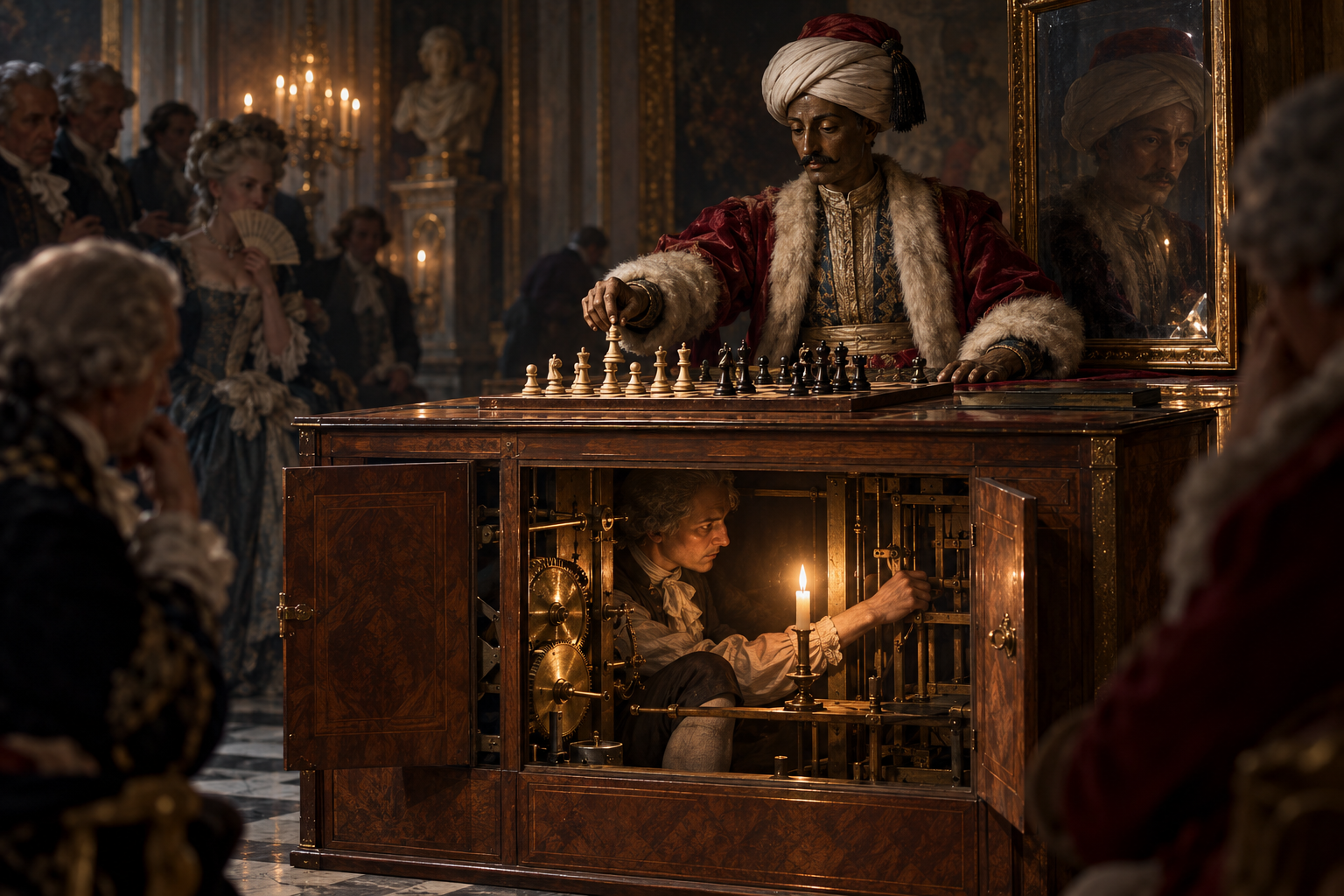
In the spring of 1770, inside the Great Gallery of Schönbrunn Palace in Vienna, a Hungarian inventor named Wolfgang von Kempelen unveiled a creation that would captivate the royal courts of Europe. It was a life-sized wooden figure carved with Ottoman robes and a turban, seated behind a large maple cabinet filled with brass gears, clockwork springs, and iron levers. It was known as "The Turk," and its creator made a startling claim: this mechanical mannequin could play grandmaster-level chess against any human opponent.
For more than eighty years, The Turk toured Europe and the Americas, defeating statesmen, scientists, and monarchs, including Benjamin Franklin and Napoleon Bonaparte. Spectators watched in astonishment as the carved wooden hand lifted rooks and knights across the board, executing brilliant tactical combinations. Intellectuals debated whether mechanical levers had finally captured the mysterious spark of human intellect.
The secret of The Turk was eventually revealed. Hidden deep inside the cramped cabinet beneath the brass gears sat a living, breathing human chess master, operating the levers by candlelight, sweating in the dark, and supplying the genuine human mind behind the illusion.
The story of Kempelen's automaton is not merely an entertaining historical hoax. It is a mirror. For centuries, human beings have harbored a deep obsession with building machines in our own image. Today, we stand in a moment where the cabinet is no longer a parlor trick. Neural networks and large language models write software, compose fluid prose, draft legal briefs, and analyze complex financial systems in seconds.
Yet as the machinery grows exponentially more convincing, we are forced to confront the deeper question that The Turk merely obscured: When tools become capable of reproducing the intellectual outputs we once considered distinctly human, what remains ours to be responsible for?
Capability Versus Responsibility
Several years ago, I read Dan Brown’s novel Origin, which centered on two ancient, relentless questions: Where do we come from? Where are we going? At the time, its collision of artificial intelligence, neuroscience, and theology felt like an intriguing speculative exercise set slightly in the distance. Today, we are living directly inside those questions.
When people discuss technological change, the conversation almost always turns to limitations: What will machines never be able to do? History shows that is a fragile foundation for human identity. Human beings have repeatedly underestimated what mechanical systems would eventually accomplish, only to watch machines surpass us in calculation, pattern recognition, chess, translation, and analytical speed.
A far more durable question is not what machines can eventually do, but what remains ours to be responsible for.
Capability and responsibility are fundamentally different things. A software architecture can assist judgment, but a human being must live with the consequences of a decision. A language model can generate moving essays about fatherhood, but it cannot sit beside a sick child through the night. A machine can analyze the historical mechanics of sacrifice, but it bears no personal cost for the sacrifices we choose to make. A system can process medical data about mortality, but its life is not finite; ours will actually end.
The true danger of our era is not merely that machines will imitate human thought, but that human beings will abdicate the moral burden of human action. It is the mistake of assuming that because a system can calculate an answer, it can also carry the weight of a choice.
The Matter of Creation
There is a subtle deception in the vocabulary of modern technology. We talk about "the cloud" as if computing exists in an ethereal, floating realm far above the physical world.
The cloud is not a cloud.
Beneath every algorithm sits a massive, unyielding physical architecture: acres of land, steel structures, high-performance silicon processors, copper wiring, rare earth minerals, millions of gallons of cooling water, vast electrical grids, and the physical labor of human workers. Our attempt to manufacture intelligence is astonishingly, unavoidably dependent upon matter.
Human beings do not create from nothing. We rearrange what already exists. We take sand and refine it into silicon chips. We take rivers and coal and convert them into electricity. We take generations of accumulated human language, literature, and philosophical inquiry, convert them into data, and feed them into training pipelines.
This realization changes how I view creation itself. In classical theology, God is Creator in an absolute sense: bringing existence into being from nothing. Human creation, by contrast, is always derivative. We inherit raw materials, and we attempt to shape something meaningful from what was handed to us.
That is as true of family lineage as it is of technology. I did not create myself. I inherited a foundation built by people who came before me. My grandparents (James, Celia, Robert, and Shirley) worked through hard, restrictive eras to create the conditions under which their children could build. My parents, Gerald and Roxana, inherited that foundation and sacrificed continuously to create a solid floor beneath my siblings and me. Today, my wife and I stand in that same line, raising our daughters.
Every generation receives a set of physical, cultural, and spiritual materials it did not manufacture. Our responsibility is to receive that inheritance with gratitude and shape something worthy from it for those who follow.
Beyond the Metric of Utility
For generations, we have allowed our economic culture to confuse human value with economic usefulness.
During the Industrial Revolution, machines displaced physical labor. During the Information Age, computers amplified intellectual labor. Today, artificial intelligence automates portions of thinking itself. This creates a deep existential crisis for a culture that has taught people to answer the question Who are you? with a description of what they produce.
If a person's worth is measured strictly by processing speed, economic output, or market efficiency, then an age of increasingly capable machines will inevitably make them feel obsolete. But that crisis is not created by the machine; it is created by a mistake we made long ago when we allowed economic productivity to become our measure of human dignity.
A newborn child produces nothing, yet her inherent value is absolute. An aging parent loses economic productivity, yet their human worth remains untarnished. Love does not demand a return on investment.
Perhaps we need to reconsider what it means to describe humanity as being made in the image of God. If we treat raw intelligence as the primary definition of the imago Dei, we trap ourselves in a narrow view of personhood. But if the image of God involves a combination of relationship, moral agency, stewardship, freedom, creative love, and the ability to recognize sacred value in another person, then intelligence was never the entirety of the image. By attempting to manufacture intelligence in our likeness, we may finally discover what was truly valuable about us all along.
Aristotle spoke of phronesis: practical wisdom, the cultivated ability to deliberate well about how a person ought to live a good life. And the ancient practice of the Sabbath reminds us that creation did not culminate in endless, relentless production, but in holy rest. A civilization racing to build machines that run continuously needs the Sabbath more than ever, if only to remember that human beings were made for communion rather than continuous throughput.
Wisdom Under the Sun
Time is no longer an abstract concept. We are all aware that our days are finite, and that realization alters how we view efficiency.
Technology always promises to save us time. An intelligent system can draft a document, analyze a dataset, or automate a workflow in seconds, handing back hours of our week. But efficiency is an instrument, not a purpose. It contains no answer to the most vital question: Save time for what?
If technology gives us ten hours back, where do those hours go? Do we funnel them right back into more work, more ambition, and another business venture? Or do we give them to our spouses, our children, our aging parents, our friends, to silence, or to God?
Efficiency tells us how quickly we can reach a destination. Wisdom asks whether the destination was worth the journey in the first place.
Here is the quiet divide between machine processing and human judgment: a software model has no mortality. It experiences no passage of time, no urgency, and no loss. It can analyze the concept of opportunity cost, but it never bears the pain of choosing one path while watching another permanently close. Saying yes to one decision means surrendering a portion of a finite human life that can never be replenished.
An algorithm can generate a poetic description of watching children grow up, but our children are actually growing up right now while we decide how to spend our afternoons. An algorithm can write a treatise on death, but it will never stand beside a grave. Intelligence without mortality cannot mean the same thing as wisdom.
The Parental Charge
As parents, these questions cease to be theoretical. They become our primary responsibility.
My parents, Gerald and Roxana, raised my siblings and me for a world they could not fully predict. Their parents did the same for them during periods of economic hardship, war, and rapid social change. Now, my wife and I face that same ancient parental charge in an era of unprecedented technological transition.
I cannot tell my daughters, exactly what their labor market will look like in fifteen years. I cannot predict which technical skills will retain economic value, or what software landscape will surround them when they establish their own households.
Because we cannot give our children a fixed map of the future, preparing them cannot mean simply drilling them with the correct answers for today. It means forming the kind of character capable of making sound choices when the answers change.
Our responsibility as parents is to help the next generation learn to distinguish between things that look similar on the surface but are vastly different underneath:
- To distinguish knowledge from wisdom,
- To distinguish capability from purpose,
- To distinguish efficiency from meaning,
- To distinguish information from truth,
- To distinguish attention from love,
- To distinguish economic usefulness from human worth,
- And to distinguish raw intelligence from moral judgment.
That is what self-determination will mean in their generation: not possessing a pre-packaged answer for every scenario, but knowing how to deliberate, how to love, and how to govern oneself when surrounded by noisy, artificial abundance.
The Four Scales of a Finite Life
As we reflect on this technological threshold, our thinking moves across four distinct scales:
- Humanity: Where did we come from, and where are we going?
- Technology: What happens when the tools we manufacture begin to mirror the intellectual outputs through which we defined our uniqueness?
- Generations: What have we inherited from those who came before us, and what are we building for our children to inherit from us?
- Mortality: Knowing that our time on this earth is limited, what deserves the remaining hours of the life that bears our name?
These thoughts are not offered as a warning against technology, nor as a naive declaration that machines will solve our deepest human problems. They are certainly not intended to use God as a simple explanation for whatever science has not yet mapped out.
Instead, we can treat this technological moment as a mirror. The most consequential thing artificial intelligence reveals will not be something about machines. It will be something about us.
Like the spectators standing before Wolfgang von Kempelen's Turk in 1770, we are being forced past the illusion of the cabinet. We are being asked, with an urgency that no previous generation faced, to step past the noise of efficiency and decide what a human life is actually for.
“Where do we come from? Where are we going?”
Sources and Methodological Context
- Standage, Tom. The Turk: The Life and Times of the Famous Eighteenth-Century Chess-Playing Machine (Walker & Company, 2002). Historical documentation of Wolfgang von Kempelen's 1770 automaton.
- Brown, Dan. Origin (Doubleday, 2017). Philosophical framework examining humanity's origins and technological trajectory.
- Arendt, Hannah. The Human Condition (University of Chicago Press, 1958). Categorization of human activity into labor, work, and action.
- Aristotle. Nicomachean Ethics. Conceptualization of phronesis (practical wisdom and moral judgment).
- Theological Foundations: Classical metaphysical accounts of creation ex nihilo, the imago Dei (Image of God), and the Sabbath as a cessation from production.
- Author Platform & Official Publications: www.germarreed.com.