
We Are in Here With You: Black Men, Political Agency, and the Power of Being Heard
We Are in Here With You: Black Men, Political Agency, and the Power of Being Heard
What happens when a demographic that has long been treated as a turnout lever decides to articulate its own terms of engagement?
“What happens when you realize we are not just in here with you, but you are in here with us?”
A seasoned contractor once described an illustrative parable about an old factory where the furnace room broke down during a brutal winter. The owner of the firm walked through the chilled corridors with an air of absolute possession. He held the deed to the building, managed the capital accounts, issued the paychecks, and operated under the quiet conviction that every worker on the floor was indebted to him for their livelihood. When the steam pipes clattered and went dead, he called the maintenance crew down into the basement and delivered an exasperated lecture, telling them what they ought to do, how grateful they should be for the facility, and what consequences would follow if the heat was not restored by sunrise.
The men listened in respectful silence. They were machinists, pipefitters, and welders whose trade craft had kept the mechanical skeleton of the plant running for years. When the owner finished his address and turned to leave, the oldest pipefitter looked down at his wrench, looked back up at the owner, and quietly pointed out that without their hands turning the manual valves, the pipes would freeze, the boilers would crack, the insurance would lapse, and the building would become worthless before morning.
The revelation was not that the men were staging a mutiny. They had no interest in seeing the plant freeze. The revelation was far quieter and more profound: the dependency in that basement had never been one-directional. The owner believed he was providing shelter to men who had nowhere else to turn. The men understood that they were the living skeleton keeping the roof over his head. The moment that truth entered the room, the terms of engagement shifted without a raised voice.
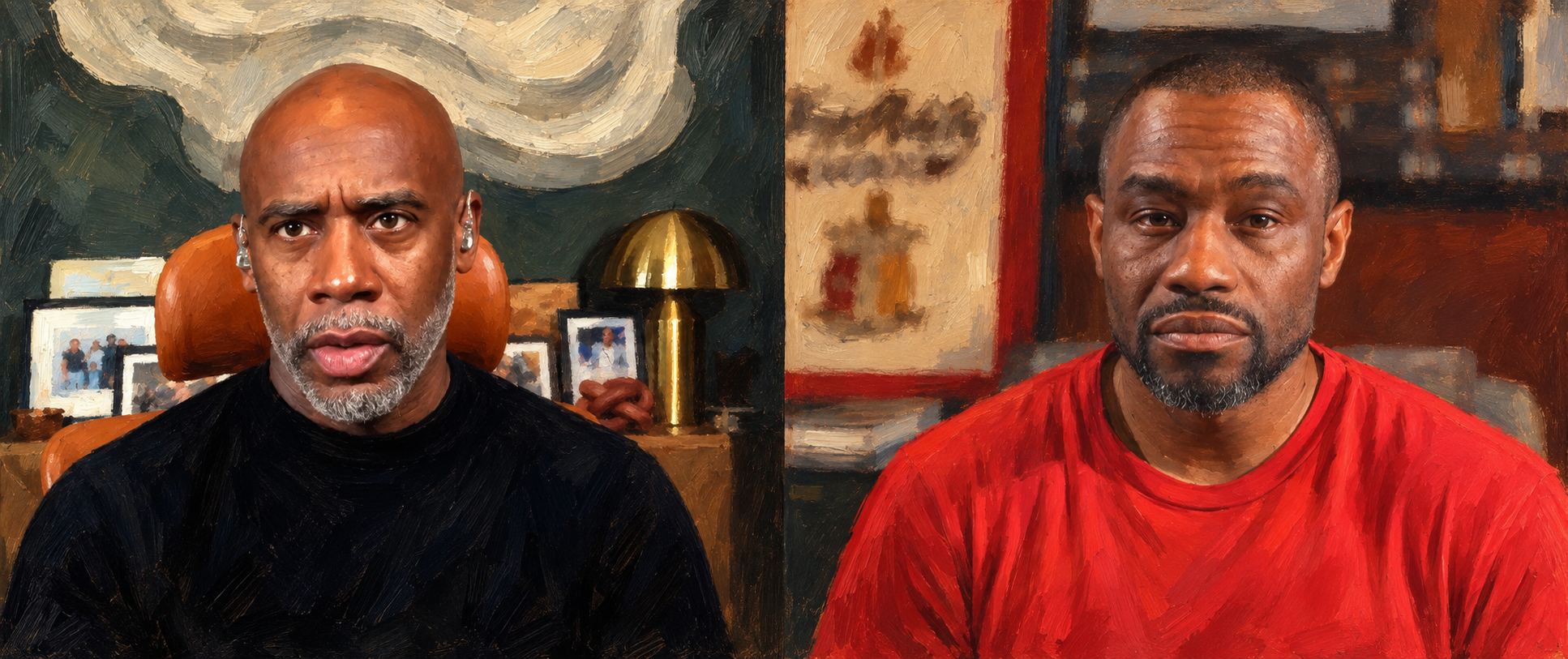
In this essay, “we” refers principally to Black American men, not as an ideologically uniform bloc, but as people with overlapping cultural, economic, and familial experiences whose priorities deserve direct articulation. I thought about that basement while watching the premiere episode of Jeff Johnson’s digital series No Translation, particularly his extended dialogue with Dr. Marc Lamont Hill. Across two hours of honest reflection, Johnson and Hill cut past the scripted talking points that usually characterize panel discussions about Black male voters. Near the center of their dialogue sat an observation that has remained with me ever since: what American politics commonly describes as a Black male turnout problem is also, and perhaps more fundamentally, a Black male listening and relationship problem.
The Listening Problem: Beyond Downstream Polling
For decades, major political apparatuses have treated Black men less as full civic partners with complex priorities and more as an electoral reserve corps to be mobilized ninety days before a general election. The questions asked about Black men by network commentators and campaign consultants are almost entirely downstream: Will Black men turn out in Philadelphia, Detroit, Milwaukee, and Atlanta? What percentage will peel away toward the Republican ticket? Are younger cohorts drifting toward conservative messaging? How can party operatives cajole them back into historical voting lines?
These inquiries are convenient for post-election panel summaries, but they examine human beings like utility meters. Downstream questions look only at the board on election night. Upstream questions examine how men are surviving between elections.
Before a Black man is a voter, he is a man. Politics encounters him for five minutes inside a voting booth every two or four years. Life encounters him at 6:00 AM every single morning. Upstream reality is about whether he can earn an honest living that outpaces the relentless grind of inflation. It is about whether he can afford housing costs, secure health coverage for his children, navigate local policing, and lay his head down at night without a quiet panic about whether his household savings can weather an unexpected medical diagnosis or a sudden layoff.
In national research presented by Terrance Woodbury and the polling firm HIT Strategies, Black men across the country consistently identified the cost of living, good-paying jobs with real benefits, financial independence, and emotional well-being as their highest daily priorities. Yet Woodbury’s data highlighted a sobering finding for the political establishment: among the core economic issues tested, younger Black men did not view elected Democrats as leading the national conversation or delivering measurable solutions on a single one of them. While national platforms offered symbolic gestures, the daily balance sheet of the working-class household continued to tighten.
"A political party that calls you only when it needs your labor does not approach you as a partner; it utilizes you as a utility. Real partnership begins by asking what the worker requires before the whistle blows."
Jeff Johnson described No Translation as a love letter to Black men precisely because it created a venue where men could converse without an external interpreter editing the exchange. In the presence of Dr. Hill, the dialogue moved past grievance and into the everyday terrain of human living: fatherhood, childhood trauma, vulnerability, physical health, the difficulty of maintaining brotherhood in an isolated economy, and the spiritual cost of performing composure while carrying unacknowledged stress.
The Hearth and the Horizon: Men, Women, and Mutual Respect
Any serious examination of Black male agency must address the relationship between Black men and Black women with care, truth, and deep affection. In contemporary media ecosystems, engagement-optimized algorithms frequently reward content that pits Black men and women against one another, elevating sensational podcasts, bitter dating debates, and manufactured gender grievances for digital clicks. We must refuse that trap.
At the same time, we must confront the political rhetoric that has distorted this relationship. For years, party consultants and media commentators have repeated the familiar refrain that Black women are "the backbone of the Black community." While framed as praise, that slogan often serves a double purpose in practice: it offers Black women cheap symbolic flattery in place of measurable material wealth, while subtly erasing Black men from the structural foundation of our own people. It implies that our community survived on the shoulders of one gender alone, as if Black men were merely spectators, liabilities, or absentee tenants in the house they helped construct.
History tells an entirely different story. The survival, resistance, and advancement of Black America has never been a single-gender project. It was forged by two co-equal pillars standing shoulder to shoulder against unrelenting pressure. Alongside the extraordinary courage of Harriet Tubman, Ida B. Wells, and the grandmothers who anchored our civic and church life, stood Black men who swung sledgehammers on railroad beds, poured iron in foundry furnaces, cleared southern timber, and worked double shifts on factory assembly lines to put roofs over our heads. It was Black men who stood armed on country porches at night to protect their wives and children from night riders, who built fraternal lodges and mutual aid societies from pocket change, and who walked picket lines demanding wages that could sustain a household.
To honor Black women does not require diminishing Black men, and to speak of Black male strength does not take anything away from our sisters. Our community has two hands, two eyes, and two lungs. When political rhetoric elevates one while scolding the other, it creates artificial division rather than durable strength.
A brother who expresses economic frustration, who questions whether decades of uncritical party loyalty have yielded tangible balance-sheet returns, or who advocates for stable family life and responsible paternal authority is often subjected to immediate political correction. Paternal authority is not bluster or domination; it is stewardship demonstrated through presence, financial responsibility, protection, emotional maturity, and the patient formation of children. Asking what a political coalition plans to deliver to the man who works sixty hours a week is not an attack on anyone; it is the basic requirement of self-respect.
There is a profound and decisive difference between saying, “I love you, therefore I know what you need,” and saying, “I love you, therefore I want to hear you tell me what you need.”
Black women possess every right to articulate their specific civic, health, and economic priorities: from maternal health protections to wage equity and legal safeguards. Black men possess that exact same right. A man who desires safe neighborhoods, living wages, equitable custody in family courts, capital for commercial trades, and the dignity to provide for his family is not competing with Black women; he is preparing to stand firmly beside them. We are husbands and wives, fathers and mothers, sons and daughters, brothers and sisters. Healthy community life requires the maturity to sit at the kitchen table, listen to each other's experiences without defensiveness, and build a unified household strategy where neither party is forced to become a silent partner.
The Power of an Articulated Agenda and the Demands of Leverage
What happens when Black men stop waiting for outside institutions to define their priorities and begin assembling their own ledger? One of the most notable developments in independent political thought is the Black Male Political Agenda (BMPA), spearheaded by Dr. T. Hasan Johnson.
The primary significance of the BMPA does not depend on whether an individual agrees with every policy plank or legislative recommendation contained within its text. Its fundamental importance rests upon a simpler, revolutionary fact: someone actually took the time to ask Black men what they wanted, and thousands of Black men answered.
Drawing upon an active community of over 30,000 participants within the Onyx Report network, Dr. Johnson and his collaborators constructed a crowdsourced, participatory policy platform. Rather than having consultants in Washington draft focus-grouped soundbites, the agenda was developed through direct community voting, debates, and surveys across several practical domains:
- Paternity and Family Court Reform: Establishing legal presumptions of shared physical custody for fit fathers, reforming child support calculations that penalize low-income parents, and dismantling structural barriers that separate children from present fathers.
- Economic Mobility and Entrepreneurship: Expanding commercial lines of credit for male-dominated trades, funding industrial apprenticeships, protecting sole proprietorships, and creating tax incentives for businesses that hire local men.
- Education and Pipeline Development: Addressing the acute crisis facing Black boys in public education, where high disciplinary rates and a severe shortage of Black male teachers, who comprise only about 1.3 to 2 percent of the national public school educator workforce, leave boys alienated from academic life.
- Health and Emotional Stability: Expanding targeted healthcare screenings for cardiovascular disease and prostate cancer, alongside accessible mental health services designed to address rising Black male suicide rates, which the CDC has documented increasing significantly over the past two decades.
- Criminal Justice, Housing, and Re-Entry: Reforming re-entry pipelines so men who have completed their sentences can regain occupational licenses, voting access, and stable housing rather than being funneled into chronic homelessness.
"A constituency capable of articulating an agenda is fundamentally different from a demographic waiting to be mobilized." The Strategic Turning Point
When a demographic has no written agenda, it is vulnerable to being mobilized purely through emotion, fear, and heritage, summoned by appeals invoking the sacrifice of civil-rights martyrs to demand compliance with living politicians who offer little in return. But putting demands on paper changes the dynamic: it establishes an audited framework for civic engagement.
Yet an agenda is not yet leverage. Leverage appears when an agenda is backed by institutions, representatives authorized to negotiate, voters willing to reward or punish, resources that can be directed, and measures that reveal whether the bargain was honored. Articulation allows Black men to name their interests. Organization determines whether anyone must respond. Political power follows a disciplined progression: recognition, articulation, aggregation, organization, negotiation, implementation, and rigorous accountability.
The Hard Landscape: Facts Beyond Caricature
To engage Black men honestly, we must clear away the lazy cultural caricatures that have long masqueraded as sociological analysis. The most enduring of these myths is the stereotype of the universally absent, indifferent Black father.
The empirical record demonstrates a far more nuanced picture. In a landmark National Health Statistics Report published by the Centers for Disease Control and Prevention (CDC), researchers examined father involvement among men aged 15–44 using National Survey of Family Growth data collected from 2006 through 2010. Measuring reported daily parenting activities during the four weeks prior to interview, the CDC found that Black fathers living in the same household with their young children led fathers of other racial and ethnic groups in several measured daily-care duties. Black co-residential fathers had the highest participation rates for daily bathing, dressing, or diapering their children under age five (70.4%, compared to 60.0% for white fathers), feeding their children daily, and helping older children with homework on a daily basis.
Even among non-residential fathers, federal data documented significant ongoing connection, with many Black fathers maintaining daily contact, talking with their children, and attending school or athletic events. Family instability in our community is not rooted in an innate deficiency of paternal love. It is shaped by a complex matrix of factors: an economic and industrial restructuring that decimated working-class male wages, benefit formulas in public assistance that historically penalized two-parent households, and family court systems that too often operate as adversarial debt collection bodies rather than family-stabilization supports.
Consider the broader economic landscape. According to official data from the U.S. Census Bureau’s 2022 Annual Business Survey (ABS), Black-owned employer businesses grew to 161,031 firms nationwide, supporting more than 1.4 million workers and generating over $183 billion in annual revenue. While these Census figures describe Black employer firms as a whole rather than male-owned enterprises exclusively, they reflect an expanding entrepreneurial ecosystem. Many Black men are anchoring small construction trades, logistics firms, tech ventures, and commercial shops despite the fact that the Federal Reserve's Survey of Consumer Finances confirms median Black household wealth remains roughly 15 to 20 percent of median white household wealth.
In the 2024 presidential election, survey data from the national AP VoteCast study of more than 120,000 voters indicated that approximately 78 percent of Black men cast ballots for the Democratic ticket of Kamala Harris, while approximately 21 percent voted for the Republican ticket of Donald Trump. Rather than reflecting an ideological monolith, the data confirms that Black men remain a heavily Democratic-leaning demographic second only to Black women in national coalition support. The lesson of that vote is not that Black men are defecting en masse, but that many Black men, particularly younger cohorts, are beginning to ask a very basic question: What exactly is the offer?
Confronting the Counterarguments
A serious strategy must confront its strongest counterarguments directly. Several legitimate objections are often raised against an explicit Black male agenda:
- The Diversity of Ideology: Black men do not share one political ideology or single set of priorities. A union pipefitter in Detroit, a software engineer in Atlanta, and a small business owner in Houston evaluate the economy through distinct lenses. Many of their priorities overlap completely with those of Black women, families, and the broader community.
- Listening Is Not Policy Delivery: Being heard does not automatically translate into legislative execution. A candidate can hold town halls and nod sympathetically in barbershops while failing to deliver a single municipal procurement contract, tax credit, or judicial reform once inaugurated.
- The Complexity of Turnout: Changes in voter participation stem from multiple intersecting causes: structural voting barriers and registration purges, lack of voter mobilization, direct candidate preferences, regional economic despair, or deliberate civic refusal. Treating every decline in turnout as a conscious political boycott oversimplifies election mechanics.
- The Risk of Gender Division: Articulating male-specific priorities can produce strategic clarity, but it can also be exploited by sensational media actors to foment toxic gender friction that harms both Black men and Black women.
- State Variations in Family Law: Family-court and child-support statutes vary significantly by state jurisdiction and involve complex considerations regarding child welfare, parental financial responsibility, and child safety that cannot be resolved through simplistic slogans.
These objections are real, but they do not invalidate the necessity of an articulated agenda. Rather, they demonstrate why serious organization is required. When Black men organize around specific priorities, the goal is not to divide the household or enforce conformity of thought. The goal is to ensure that our specific vulnerabilities, from educational exclusion to life expectancy and fatherhood barriers are addressed with programmatic seriousness rather than symbolic platitudes.
These findings do not show that Black men share one ideology, that every decline in turnout represents a deliberate refusal, or that listening by itself creates political power. They show something narrower and more useful: Black men’s priorities cannot be inferred from party loyalty, and any coalition seeking their support should connect listening to specific commitments, implementation, and measurable household and institutional outcomes.
The Three-Dimensional Agenda
If self-definition is our goal, a mature Black Male Agenda cannot begin and end with petitioning the state. Government policy is essential for enforcing constitutional rights, ensuring equitable procurement, and removing legal barriers. But the state cannot teach a boy how to look another human being in the eye with self-respect. The state cannot heal personal trauma, and the state cannot build brotherhood.
A complete agenda operates across three distinct tiers:
- What We Require from Government: Equal protection under the law, equitable municipal procurement, genuine family court and child support reform that encourages present parenting, investments in vocational and trade education, capital access through Special Purpose Credit Programs, and public safety policies that protect urban neighborhoods without treating every young Black man as an inherent suspect.
- What We Require from Institutions and Employers: Insisting that Black churches, fraternities, civil rights organizations, and corporate partners move beyond symbolic diversity panels. Legacy institutions must be challenged to invest their balance sheets into Black male trade apprenticeships, health screenings, commercial real estate syndicates, and legal defense funds that safeguard paternal rights.
- What We Require from Ourselves and One Another: This remains the most critical and demanding tier. If we want our boys to become responsible men, we must mentor them personally. If we want our families to be stable, we must cultivate emotional maturity, financial discipline, and personal fidelity. And if our brothers are to survive the stresses of this world, we must build friendships where a man can say, “Brother, I am struggling,” without feeling that his dignity has been compromised.
A community becomes politically mature when it stops asking only where it belongs and begins asking what the relationship produces. And a community becomes durable when it stops believing that all of its solutions must be authored by people outside of it.
The Awakening
When I first encountered the words that opened this reflection, they sounded like a warning. But as I sat with them across the days, returning to the conversation between Jeff Johnson and Marc Lamont Hill, reviewing the participatory platform of the Black Male Political Agenda, and thinking about the men in my own lineage, I no longer hear them that way.
I hear them as an awakening.
For more than a century, Black men have often been treated as if we were trapped in someone else’s house, begging for a corner of the table, grateful for whatever scraps of recognition were offered. But look at the foundation of the house honestly. Black men remain a critical component of any viable Democratic presidential coalition. The Republican Party faces a distinct demographic incentive to engage younger Black men seriously if it wishes to expand its national footprint. Commercial supply chains and cultural industries rely continuously upon Black male labor, trade skill, and consumer spending. And our churches, schools, and families depend upon the active presence, protection, and provision of Black men.
And what happens when Black men realize that we need one another and durable institutions more than we need temporary attention from politicians?
What if some of what consultants describe as low turnout reflects a quiet refusal to continue being taken for granted? What would happen if political coalitions stopped asking primarily how to get Black men to the polls and started asking what Black men are trying to build? And what would happen if Black men organized around an affirmative vision of the fathers, husbands, builders, owners, and brothers we were created to be?
“What happens when you realize we are not just in here with you, but you are in here with us?”
Sources and Verified Documentation
- No Translation Digital Series: Premiere episode featuring Jeff Johnson and Dr. Marc Lamont Hill, broadcast live on YouTube (youtube.com/live/kGf3orxC_LU).
- HIT Strategies Research: Terrance Woodbury and HIT Strategies voter research on Black male economic priorities, cost-of-living concerns, and perceptions of political party responsiveness (hitstrat.com).
- Black Male Political Agenda (BMPA): Dr. T. Hasan Johnson, crowdsourced policy platform developed with 30,000+ Onyx Report participants (thasanjohnson.com/bmpa).
- Paternal Care Statistics: Centers for Disease Control and Prevention (CDC), National Center for Health Statistics, Fathers' Involvement With Their Children: United States, 2006–2010, National Health Statistics Reports, No. 71 (Dec. 20, 2013), (cdc.gov/nchs/data/nhsr/nhsr071.pdf).
- Black-Owned Business Data: U.S. Census Bureau, Annual Business Survey (ABS) 2022 (data year 2021), documenting 161,031 employer firms, 1.4 million employees, and $183 billion in revenue (census.gov/programs-surveys/abs.html).
- 2024 Presidential Election Survey: Associated Press / NORC, AP VoteCast 2024, national survey of 120,000+ voters tracking demographic vote shares (AP VoteCast 2024 Data).
- Educator Workforce Demographics: National Center for Education Statistics (NCES), Digest of Education Statistics, documenting that Black men comprise approximately 1.3 to 2.0 percent of public school teachers nationwide (nces.ed.gov).
- Wealth Gap Baselines: Federal Reserve Board, Survey of Consumer Finances (SCF), tracking household net worth distributions (federalreserve.gov/econres/scfindex.htm).