
The Mirror of the Lineage: Why Children Reflect What We Embody, Not What We Say
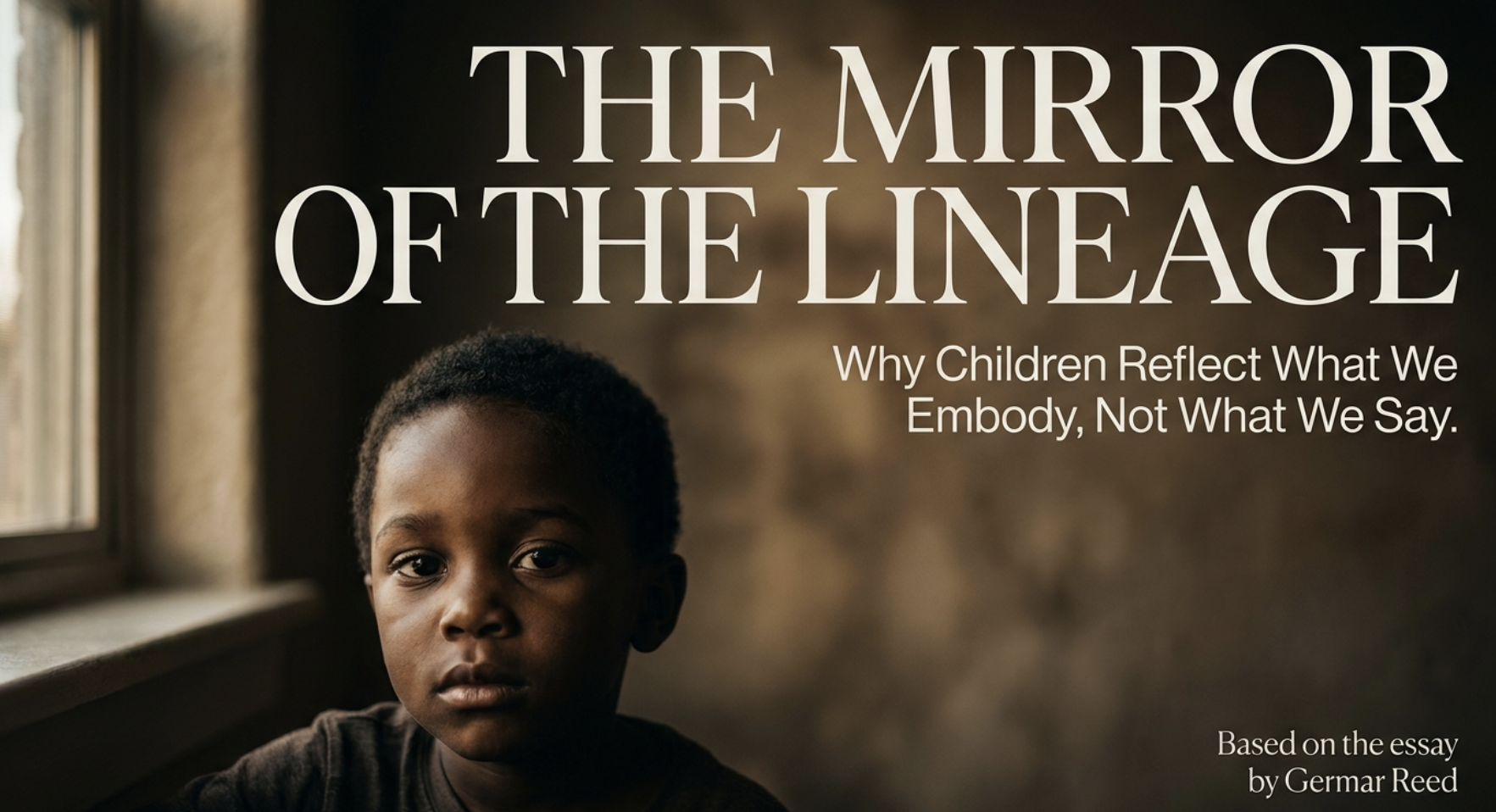
The Mirror of the Lineage: Why Children Reflect What We Embody, Not What We Say
When an orchard begins producing bitter fruit, no farmer punishes the fruit. He examines the health of the soil, the water, and the root system. Yet when a child struggles, modern culture pathologizes the child while redefining the family to shield adult choices from accountability.
When an arborist walks through an orchard and notices a tree producing stunted or bitter fruit, his immediate instinct is never to blame the fruit. He does not yell at the branch, nor does he attempt to lecture the apples into sweetness. He knows that the fruit is merely an outcome, the visible end of an invisible process. To understand why the fruit tastes the way it does, he must examine the depth of the soil, the purity of the water table, the sunlight entering the canopy, and the overall health of the root system.
In our modern approach to raising children, however, we do the exact opposite. When a child demonstrates anxiety, volatility, defiance, or withdrawal, society rushes to isolate and pathologize the child. We bring in specialists, assign behavioral labels, and construct elaborate diagnostic protocols designed to fix the individual offspring, all while remaining completely blind to the emotional climate of the home that conditioned them. We attempt to reform the fruit while leaving the soil contaminated.
Our ancestors understood a deeper, far more exacting truth: children are not merely the future of a family; they are its living barometer. They are the immediate feedback loop of the lineage. When an elder observed a child struggling, they did not ask, “What is wrong with this child?” They asked a far more unsettling question: “What is this child reflecting?”
Comforting Adult Choices at the Expense of Children
Over the past few decades, our conversation surrounding family structure has undergone a subtle, damaging shift. In the Black community, where self-respect was once tied to building unshakeable, self-reliant households, we have increasingly embraced creative definitions of family. We have invented new vocabularies and flexible arrangements designed primarily to make adults feel better about their decisions, rather than confronting the reality of what children actually require to thrive.
When adult commitments fail, or when short-term desires override long-term duty, society steps in to sanitize the compromise. We label fragmented arrangements as equally valid choices. We pretend that every household configuration yields the same spiritual, emotional, and psychological stability for a growing mind. But this is a form of self-deception that undermines our collective strength.
"Every child deserves to be loved and raised by the set of parents who created them. Everything else, no matter how heroic the effort, is a substitute." Delano Squires
We must have the moral courage to state what was once self-evident: the intact, two-parent home headed by a committed husband and wife is not an arbitrary cultural preference. It is the gold standard of human development. Single mothers, grandparents, and extended kin often perform heroic labor to rescue children from the fallout of male absence or marital breakdown, and their sacrifices deserve our gratitude. But an emergency rescue team is not an architectural blueprint. When we celebrate the substitute as equivalent to the original design, we lower our standards of self-respect and disarm the next generation before they ever step out into the world.
The Unspoken Transmission
Long before a child ever understands the complex syntax of spoken language, they have already mastered the energetic language of their environment. Before an infant comprehends a single rule, lecture, or moral instruction, their nervous system has been continuously scanning and absorbing the emotional frequency of the home. They drink in the parent's peace, panic, unspoken resentment, hidden fear, and unexamined grief as naturally as they absorb air.
We often operate under the comforting illusion that we can insulate our children from our internal turbulence simply by keeping our voices low or delivering articulate lectures about self-control. But children are hyper-attuned observers. They do not listen to our words with their ears alone; they read our posture with their instincts. They feel the unspoken tension vibrating beneath a quiet dinner table; they register the underlying anxiety behind a parent's frantic overachievement; they sense when a home is governed by genuine peace or merely an uneasy truce.
"Children rarely become what we tell them to be. They become what they witness us embodying." The Law of Environmental Conditioning
This is why verbal instruction divorced from lived embodiment always fails. A parent who habitually reacts to stress with explosive anger cannot teach a child emotional regulation through a stern lecture on patience. A parent whose daily life is driven by unspoken fear cannot demand that a child step boldly into the world with unshakeable courage. The child’s nervous system will always prioritize what it witnesses over what it is told.
Behavior as Feedback, Not Pathology
Once we accept that the child is a mirror, every behavior transforms from a discipline problem into an informative signal. The acting-out child is often expressing the unexpressed tension in the household. The anxious child is frequently holding the unacknowledged fear of a parent who refuses to show vulnerability. The closed-off child is often mirroring a domestic environment where emotional honesty was treated as an unsafe exposure.
Every pattern is a message. Every symptom is a piece of data sent back from the edge of the lineage. When we approach parenting solely through the lens of control, demanding immediate behavioral compliance without investigating the source, we are simply attempting to smudge out the reflection in the mirror without washing our own face.
"Instead of asking, 'How do I fix my child?' the sovereign question must become: 'What is this child showing me about myself, my marriage, and my home?'" Germar Reed
This diagnostic pivot requires immense personal courage. It demands that a parent step down from the comfortable pedestal of moral superiority and enter the altar of self-examination. It requires us to look at our child’s defiance and ask whether it mirrors our own stubbornness; to look at their insecurity and ask where we have made love conditional; to look at their restlessness and ask where our home lacks true sanctuary.
Reclaiming Self-Respect and Listening to the Lineage
To heal a lineage, we must stop fighting the mirror and stop making excuses for adult compromise. True self-respect within our community will not be restored through corporate slogans, political programs, or clever rationalizations. It begins when men and women take full responsibility for the homes they create, honoring the covenant of marriage and providing their children with both a father and a mother under one roof.
When a father cultivates genuine internal order, learning to govern his own fears, process his own anger, and honor his marital vows, the atmosphere of his home shifts immediately. When a mother establishes true peace within her own mind, her children no longer have to carry the silent burden of her unspoken anxiety. The soil becomes rich again, and the fruit naturally follows.
If you want to know the true condition of a family tree, do not look at its titles, its wealth, or its public declarations. Listen to the children. They are telling you the truth about the root.