
Inheritance, Armor, and the Tragic Choice of Fatherhood
Inheritance, Armor, and the Tragic Choice of Fatherhood
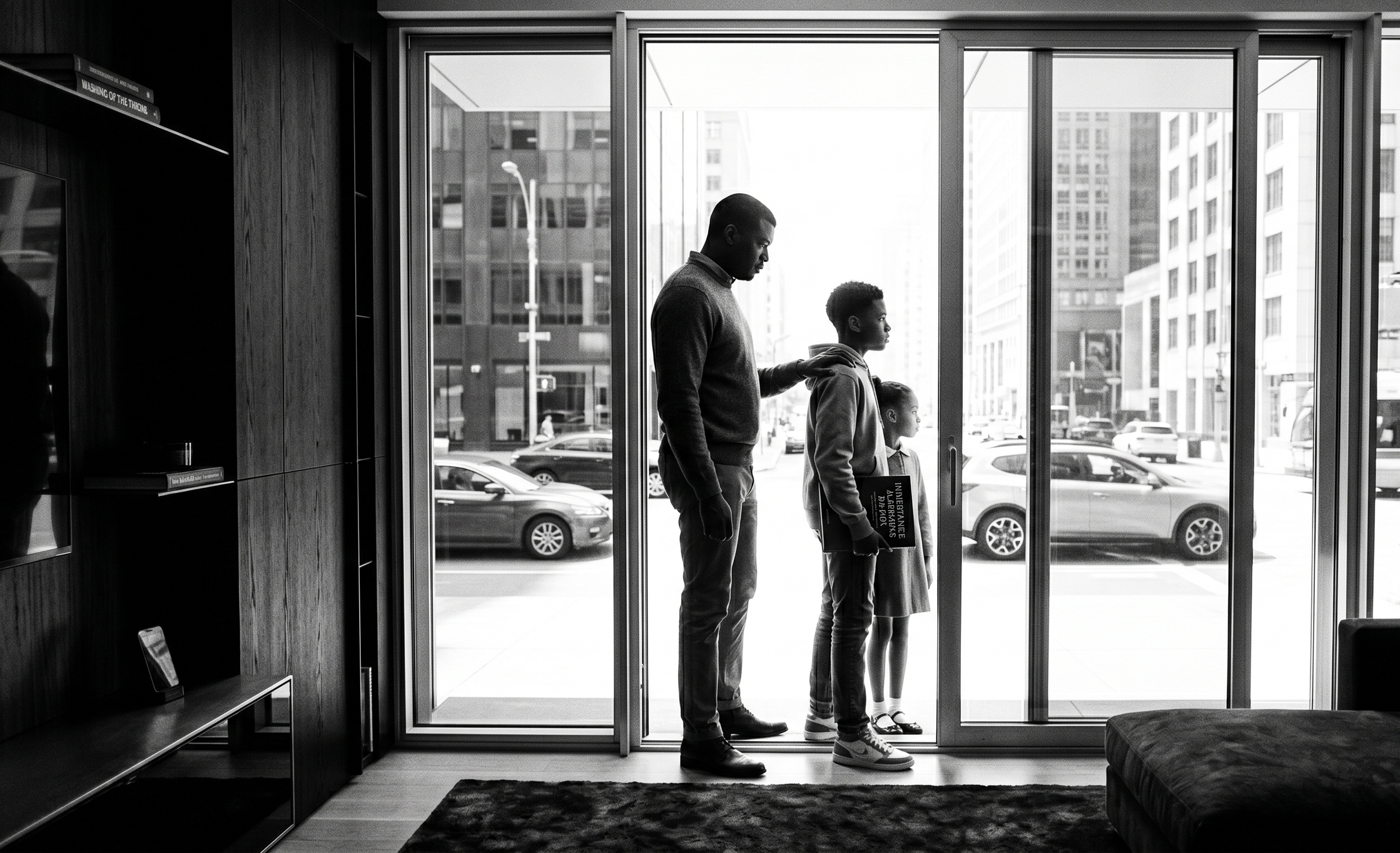
Two incompatible software systems of survival running inside the same house. To choose the expansion of the sky is to invite fragility; to choose the density of iron is to limit the touch. When the ground turns to fire, a father must finally decide which sacrifice he will sign his name to.
In the late autumn of 1895, the crisp air of Atlanta bore witness to an intellectual schism that would permanently alter the interior design of the Black household. On the stage of the Cotton States and International Exposition, Booker T. Washington stood before a segregated audience and delivered what would later be termed the Atlanta Compromise. He argued for the foundation—for the brickyard, the forge, the soil, and the slow, unglamorous accumulation of material self-reliance. He insisted that political agitation and the pursuit of higher liberal arts were empty exercises without the prior security of economic density.
From a distance, W.E.B. Du Bois watched with an increasingly sharp dissatisfaction. Within a few years, he would articulate a counter-thesis that would define the aspirational elite of the twentieth century: the doctrine of the Talented Tenth. Du Bois argued that a community could not be saved by its manual laborers alone; it required a vanguard of intellectuals, artists, and professionals who had mastered the highest expressions of human thought. He believed that to restrict a child’s education to the forge was to concede their spiritual defeat before the battle had even begun.
One might observe that this historic debate is not a dead chapter in an archive. It is the active, uncredited script running inside every Black home across the republic today. When a father stands over his child’s bed in the quiet hours of the night, he is not merely contemplating the immediate anxieties of tuition, curfews, or career trajectories. He is wrestling with the unresolved friction between Washington and Du Bois. He is deciding whether his primary duty is to build an environment of absolute fortification or to grant his child the freedom of absolute expansion.
This tension is not a riddle to be solved by a comfortable compromise. It is a fundamental choice between two competing software programs for survival in America—and to choose one is to systematically sacrifice the other.
The Linear Staircase and the Cyclical Wheel
To understand the structural incompatibility of these two paths, we must look to an older, universal conversation on the nature of generational time. In the spring of 1780, while navigating the volatile landscape of a nascent American republic, John Adams wrote a letter to his wife, Abigail, that offered one of the most celebrated formulations of linear progress in Western letters:
“I must study Politicks and War that my sons may have liberty to study Painting and Poetry Mathematicks and Philosophy. My sons ought to study Mathematicks and Philosophy, Geography, Natural History, Naval Architecture, Navigation, Commerce and Agriculture, to give their Children a right to study Painting, Poetry, Musick, Architecture, Statuary, Tapestry and Porcelaine.” John Adams, 1780
Adams’s statement imagines history as a majestic, upward staircase. Each generation accepts a specific form of trauma or labor so that the next might occupy a higher, more refined square of human existence. Hardship is not the destination; it is the currency paid to purchase a lighter, more beautiful sky for those who follow. The father enters the winter of war so that the grandchild may enjoy the summer of the arts.
Against this linear optimism stands a starker, darker aphorism, formulated in contemporary literature by G. Michael Hopf but rooted in ancient cyclical theories of civilization:
“Hard times create strong men. Strong men create good times. Good times create weak men. And weak men create hard times.” G. Michael Hopf
This second framework rejects the staircase entirely and introduces the wheel. It suggests that peace and prosperity are not assets to be inherited, but hazards that induce an inevitable softness. Where Adams sees the absence of struggle as the ultimate victory of fatherhood, Hopf’s logic sees the absence of struggle as a biological trap. Adams says, in effect, “I fight so my children do not have to.” Hopf warns, “If your children do not learn to fight, the world will eventually break them.”
For the Black father, these two historical philosophies are not academic exercises. They are the twin axes of a deep, psychological gravity. They force a choice between two entirely different parental identities: the Father of Inheritance and the Father of Armor.
The Curriculum of the Sky: The Father of Inheritance
The Adams-leaning father, operating under the intellectual lineage of Du Bois, views the purpose of his life as the expansion of his children's margins. He measures his success by the distance between his own childhood limitations and his child’s current access to the world. He does not want his children to live their lives in a defensive posture, permanently scanning the horizon for hostility. He wants them to inhabit the full spectrum of the human experience: literature, travel, emotional agility, financial leverage, good schools, untethered joy, and the luxury of choice.
His fatherhood is animated by a silent, magnificent vow: You will not have to become only what the world forced me to become.
This father is rarely naive about the environment his child must navigate. He knows the subtle and blunt mechanisms of structural exclusion; he has experienced the underestimated look in the corporate boardroom, the unprovoked stop on the highway, and the cold calculation of the institutional ledger. But he refuses to allow those external pathologies to dictate the internal curriculum of his home. He wants his children to be aware of danger, but he refuses to let danger become the architect of their personality.
“My son should know how to survive a police stop, but I do not want his boyhood organized around police stops. My daughter should understand danger, but I do not want danger to be the first name she learns for the world.” The Logic of Expansion
There is a profound moral elegance to this position. It asserts that our children deserve something more than a manual for survival; they deserve an inheritance of wonder. They deserve the right to walk into a room with the unshakeable confidence that they belong there, not because they are twice as good as everyone else, but simply because they are human. This father raises his children toward the sky, insisting that their dreams are not liabilities, but prophecies.
Politically and socially, this father invests his faith in the possibility of structural repair. He aligns himself with institutions that can be pressured into justice—strong public infrastructures, educational access, and legal protections. He operates under the assumption that the republic can be made answerable to his children’s humanity. His parenting is an act of radical strategic trust: he believes the ground can be leveled enough for his children to run without falling.
The fatal vulnerability of this posture, however, is its tendency toward underestimation. The Father of Inheritance can place an excessive amount of faith in the protective power of class mobility, academic achievement, and respectability. He can fall into the comforting illusion that if he provides enough exposure, enough refinement, and enough credentialing, the old, predatory realities of the world will look at his children and relent.
But history is an unforgiving critic of respectability. Wealth does not always function as a shield. A degree from an elite university cannot rewrite the ancient codes of an institutional lens that views a Black child as an existential threat before they open their mouth. The Father of Inheritance risks raising a child who is brilliantly equipped for an open sky, but utterly defenseless when the ground suddenly breaks beneath their feet.
The Liturgy of Iron: The Father of Armor
The Washington-leaning father, aligned with the cyclical logic of Hopf, begins his parenting from a darker, more unyielding premise: the world is a permanent crucible, and softness is a form of negligence.
His fatherhood is shaped by a hard, protective suspicion: No one is coming to save us, so you must have the strength to save yourself.
He does not romanticize suffering; he simply respects its reliability. He has watched promises turn to ash, policies fail to protect, and institutions exploit the vulnerable with a cold, mathematical indifference. He knows that when the structural winter arrives, the only asset that matters is the density of the individual. Consequently, his home is organized around a liturgy of iron. He emphasizes discipline, emotional containment, physical competence, punctuality, financial self-defense, and an absolute restraint over the self. He speaks in a vocabulary that can sound severe, even punitive, to those who have never had to live within a closed position: “Stop crying.” “Stand up straight.” “Don’t let anyone outwork you.” “Don’t look weak.” “Do what is required to survive the encounter and come home alive.”
To the outside observer, this strictness can look like an exercise in patriarchal dominance. In reality, it is a translation of fear into instruction. The Father of Armor is not trying to break his child; he is trying to ensure the child cannot be broken by the world. His severity is an inheritance of memory—the memory of the promotion he was denied despite his excellence, the cousin who was swallowed by the state because of a momentary lapse in judgment, or the silent, daily humiliations he had to absorb to keep the lights on. He understands that a child who cannot control their own reactions has already outsourced their autonomy to their adversary.
“I cannot make the world gentle by pretending it is gentle. If I do not harden your foundation today, the world will shatter you tomorrow.” The Logic of Fortification
Politically, this father is a minimalist. He has no strategic trust in the long-term promises of collective repair or institutional benevolence. His primary focus is the immediate security of the household and the community’s internal economy. He values the brickyard over the senate floor. He may believe the macro-system is completely rigged, yet he will demand that his child master the micro-mechanics required to win inside it anyway. He does not look for a better environment; he strengthens the organism to withstand the environment that exists.
The danger of the Father of Armor, however, is a profound and lasting overcorrection. In his relentless effort to prepare his child for danger, he can inadvertently turn the home into a barracks. He risks raising a son who knows how to survive disrespect but has no vocabulary for tenderness. He risks raising a daughter who is a master of vigilance but a stranger to rest.
When toughness becomes the only verified virtue, joy begins to look like a dangerous vulnerability, and emotional openness is discarded as a weakness. The armor protects the child from the arrow, but it also isolates them from the touch. A child raised exclusively under this liturgy may master the mechanics of survival, but they will never truly learn how to inhabit the house their father fought so hard to build.
The Geography of the Interior
The orientation of a father’s fear is rarely a matter of random choice; it is a direct reflection of historical geography and the movement of his lineage across the land.
A Black father whose family remained rooted in the soil of the American South carries a specific memory of endurance. The South, in our collective consciousness, is a landscape of complex dualities. It represents ancestral land, family graveyards, the deep gravity of the church, and the cultural anchor of the legacy institution. But it also represents the memory of Jim Crow, racial terror, and the rigid, local hierarchies that punished any deviation from the survival code. A father in this environment may lean toward armor because the terrain historically demanded a flawless reading of the room. Yet, the act of staying itself can become an argument for inheritance: We did not run; we outlasted the storm, and this soil belongs to us.
Conversely, the father whose family participated in the Great Migration inherits a different narrative—a narrative of escape that was met with a structural betrayal. His ancestors left the Southern fields for the industrial plants of the North and West, operating under an Adams-like faith that the migration was an upward staircase toward a lighter sky. But the destination answered their hope with the invisible violence of redlining, the contraction of the labor market, and the calcification of the ghetto. The result within the migration lineage is often a fractured faith—a deep, complicated skepticism that teaches the child ambition and suspicion in the exact same breath: Go out and conquer their spaces, but never forget that they are watching you with an old malice.
We see a different alignment in the suburban interior, where a father’s personal sacrifice has successfully produced a material stability. He looks at the private schools, the manicured lawns, and the corporate networks, and he wants to believe that the staircase is real. He raises his children with an explicit expectation of inheritance. Yet, even here, the environment introduces a specific pathology. His child is often an isolated figure—one of the few Black faces in the advanced placement class or the corporate suite. The father realizes that class mobility has not erased the racial lens; it has simply refined it. He is forced to deliver inheritance wrapped in a defensive casing: “You have been given the sky, but you must move through it with the precision of a soldier, because they will always look for a reason to ground you.”
This geographical mapping applies with equal force to the Black immigrant father—whether his lineage begins in the Caribbean or the African continent. His migration to the republic is a deliberate gamble on the promise of the staircase. He leans heavily toward the language of inheritance, demanding that his children convert his sacrifice into institutional credentials. But within the home, his discipline is often an uncompromising liturgy of iron: “We did not cross an ocean for you to be soft. We did not leave our home for you to become careless in a land that does not know your name.” When his children eventually encounter the specific, historical anti-Blackness of the American project, the family is forced to realize that their international credentials cannot fully exempt them from the requirements of the armor. Minor migrations do not merely move bodies. They shift philosophies. They teach families what to expect from the world: escape, betrayal, arrival, return, or endurance.
The Myth of the Synthesis
The modern intellectual instinct is to look at these two fathers and offer a comfortable, therapeutic synthesis. We want to tell ourselves that the solution is simply a matter of balance—that a father can provide armor on the street and inheritance in the living room, that he can teach caution without destroying joy, and firmness without exiling tenderness.
But under the pressure of structural reality, this balance is an illusion. The two software programs cannot run simultaneously; they cannibalize one another’s code.
If you choose to raise your child through the lens of inheritance, you must intentionally lower their defensive shield. To teach a child to be emotionally open, to trust their own vulnerability, to pursue beauty for the sake of beauty, and to move through the world with the unburdened posture of an inheritor requires you to keep them soft. You must protect them from the calcifying knowledge of the world’s malice for as long as possible. If you introduce the iron too early, you freeze the growth of the very faculties required to appreciate the sky. You cannot teach a child to fly while forcing them to carry the weight of an anvil.
“A father who tries to balance both usually ends up giving his child a compromised version of each—defenses that fail under real pressure and dreams that are heavy with anxiety.” The Tragic Threshold
Conversely, if you choose the path of armor, you must accept that you are intentionally restricting your child’s lung capacity. To forge a shield out of a child’s character requires you to systematically eliminate their fragility. You must teach them to suppress their tears, to contain their emotional vocabulary, and to treat peace as a temporary hazard that induces softness.
You cannot build a fortress out of a human soul without hollowing out the interior spaces where the arts, the poetry, and the uncalculated joys of life are meant to breathe. You save their life, yes, but you shrink their horizon to the exact dimensions of the bunker you built for them. The trade-off is absolute and unforgiving. If you choose Du Bois, you choose the beauty of the flower at the risk of its destruction. If you choose Washington, you choose the durability of the stone at the cost of its coldness. You cannot have both. When the storm arrives, a father must decide which sacrifice he is willing to sign his name to.
The Unforgiving Ledger
We are entering a historical era—characterized by the economic instability of 2026 and the systematic retraction of institutional protections—where the middle ground has completely turned to vapor. The illusion that a father can rely on the state or the corporate ecosystem to preserve his child’s humanity has been definitively shattered. The ledger is open, and it demands an unyielding alignment.
The debate is no longer about which historical quote is more elegant. The debate is an urgent, existential interrogation of the father’s own nervous system. It forces a confession about what he truly believes the American project to be.
If you believe that America is an upward staircase—a house that is currently flawed but remains structurally capable of being renovated into a sanctuary for your children—then you must choose the Father of Inheritance. You must have the courage to keep your child soft enough to inherit the sky, even if it leaves them vulnerable to the predatory forces that still roam the ground. You must bet their life on the ultimate victory of transformation.
But if you believe that America is an unceasing wheel—a permanent crucible that will always require the extraction of Black value while denying them the equity of the room—then you must choose the Father of Armor. You must have the severe discipline to harden your child for an endless winter, even if it means exiling them from the capacity for vulnerability, soft love, and uncalculated beauty. You must bet their soul on the absolute necessity of fortification.
Look at your children as they navigate the uncertain contours of this new age. Look at the quality of their movement, the depth of their laughter, and the vulnerability of their sleep. Do not comfort yourself with the lie that you can give them everything. The architecture of the world does not permit a flawless synthesis.
The room is closing in, the indicators are cooling, and the terrain is rough. The time for the balanced lecture is over. A father must choose his weapon.
Are you raising an inheritor, or are you forging a soldier? The choice belongs to you—but the consequences will belong entirely to them.