
| Outcome | Probability | The Verdict |
|---|---|---|
| Income-Driven Maternal Autonomy | 78% | High-earning cohorts increasingly treat wealth as a shield for independence (Self-Build). |
| Wealth-Induced Paternal Sharing | 81% | Professional males maintain a synergistic relationship between capital growth and legacy building. |
| The Decoupling of Marriage | 65% | Voter engagement with traditional structures declines as economic utility favors the individual over the household. |
| Structural "Black Tax" Neutralization | 42% | The paternal dividend is diluted by extended network support, reducing the speed of legacy formation. |
To understand the pedigree of this crisis, we must anchor our analysis in the "Prior." For the African American community, the "Way of the World" was defined by a family structure disrupted not by choice, but by the physical friction of history. During the mid-20th century, even amidst systemic exclusion, the Black marriage rate was one of the highest in the nation. The "Protector-Provider" archetype was the aspirational North Star, a mandate that persisted even when the market refused to pay the dividend. But as we moved into the post-civil rights era, a Bayesian update began. Education and corporate entry became the primary signals, but this entry was never symmetrical. Black women outpaced their male counterparts in degree attainment and corporate scaling at a rate that created a profound "Marriage Gap."
In the high-income enclaves of Atlanta, DC, and the Vineyard, the "Prior" has shifted from the communal to the individual. The Danish study by Jakobsen, Jørgensen, and Low provides the "Clean Room" data that explains why, in a world where the elite career removes the fear of poverty, the sexes default to different biological strategies. For the Black professional, this isn't just about the accumulation of assets: it's about the restoration of an archetype versus the protection of an hard-won autonomy. The data shows that when the state or the market provides security, the incentive to share wealth follows a gendered calculus of power.
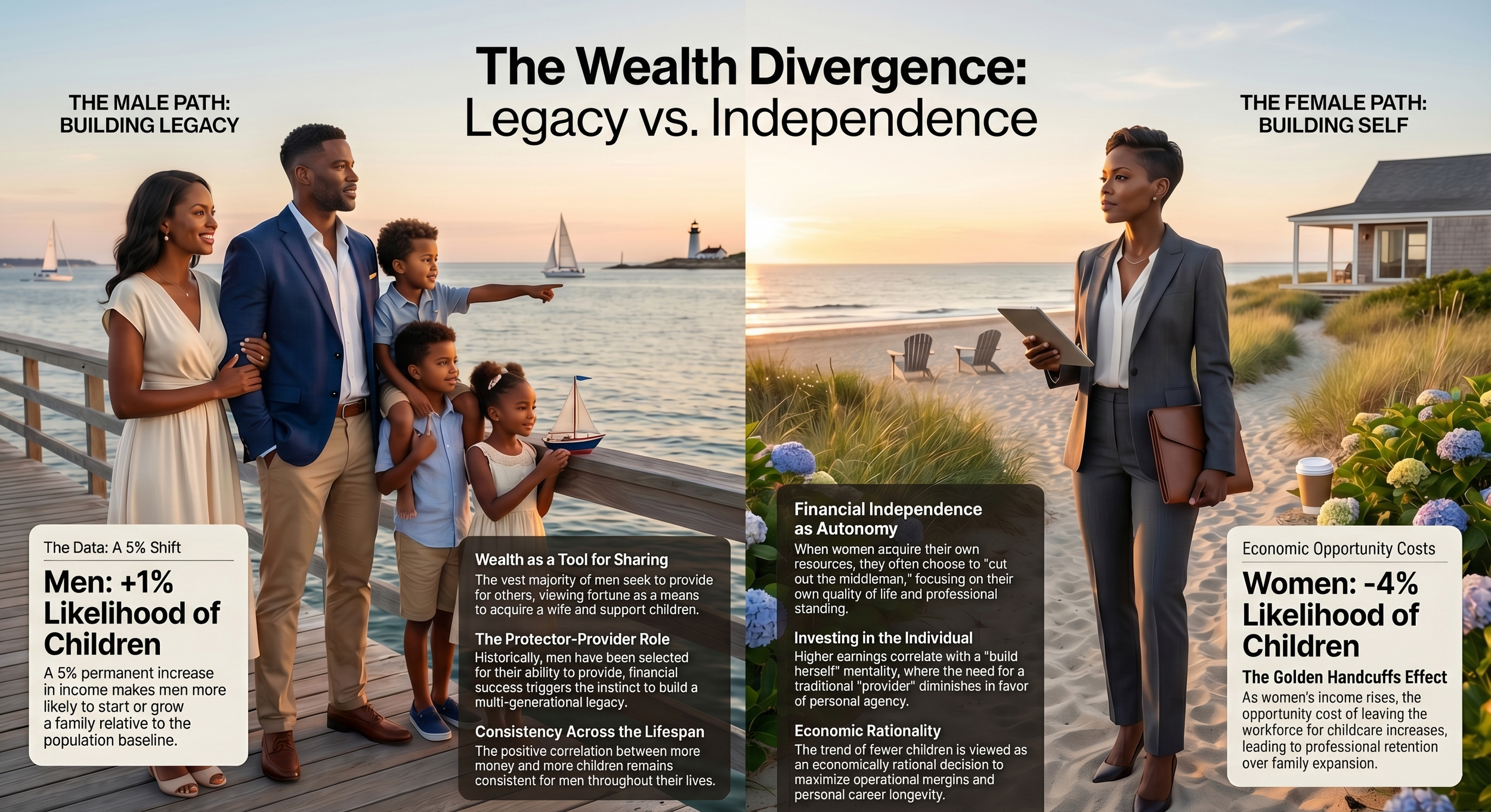
The "Paternal Dividend" represents wealth as an accelerant. The researchers, analyzing the entire Danish population, uncovered a stark asymmetry in how men and women respond to a permanent pay raise. For men, the "Income Effect" dominates. The data is clear: when men received a 5 percent permanent income increase, they became 1 percent more likely to have children. For the male, wealth functions as a green light for reproduction and communal building. This reinforces a fundamental archetypal reality: a young professional typically believes he must "make something of himself" before he can responsibly build a legacy. Career success and family formation are synergistic: they are not competing for time: they are fueling the same engine.
For the Black male professional, this "Income Effect" is the restoration of a role that was historically denied by the machinations of the market. When his bank account grows, his confidence stabilizes. He is no longer just an individual: he is a platform for the future. As the intelligence suggests, when men do well, they actively choose to share their wealth, spreading their resources to provide for a wife and children. Career success is not an alternative to fatherhood: it is the prerequisite. There is no "work-life balance" struggle in his early stages: there is only the mission to build the resource base high enough to support the weight of a household. For him, the dollar is a seed.
For the high-earning Black woman, however, the signal is entirely inverted. The Danish data shows that when women received the exact same 5 percent income increase, they became 4 percent less likely to have children. This trend remained consistently negative across their lifespans. This is the "Substitution Effect," which creates what analysts call "Golden Handcuffs." For the female professional, who has often had to work twice as hard for the same seat at the table, the higher her potential earnings, the more "expensive" a child becomes in terms of foregone career growth. For this archetype, children and high-stakes careers are in a constant, high-friction state of competition for the same limited resource: time.
We must look at the raw economic utility of these relationships. Granting women direct access to high incomes allows them to make an economically rational decision to dispense with traditional structures altogether. When a woman earns her own capital, the incentive to share that resource with a partner or a child, both of whom represent a significant draw on that resource, diminishes. The "Substitution Effect" isn't just about time: it is about the shift from "Resource Seeker" to "Resource Protector." In the context of the Black community, where women have historically been the backbone of the family, wealth provides an exit ramp from that exhaustion. The dollar serves the self: it becomes a shield for autonomy.
The "Dis-utility Gap" provides a hard signal on the physical friction of labor. Upon the birth of the first child, the psychological and physical cost of being away from the child: the "dis-utility of work": increases by 61.1 percent for women. For their male partners, the increase is a negligible 3.9 percent. This is the "Biological Tax." The friction of childbirth and the "Superwoman Schema" (the pressure to excel in every sphere) leads to a rational opting-out of the most demanding role. For the Black professional woman, this friction is compounded by the knowledge that the market rewards the "Always-On" persona, while biology demands the "Always-Present" mother. Wealth, paradoxically, makes the trade-off harder to justify.
In the SBOF framework, we must weight the "Black Tax" as a Hard Signal that complicates the Paternal Dividend. While the Danish study assumes a closed loop of individual wealth, the Black professional often supports an extended network of inertia. High-earning men are increasingly using wealth to establish "Legacy Funds," private schools, and estate planning (validating the Income Effect). Simultaneously, high-earning women are the fastest-growing segment of luxury travel and solo-homeownership (validating the Substitution Effect). The "Soft Signal" of the "Black Love" marketing industrial complex, while culturally resonant, does not move the needle on birth rates for the top decile of earners. The math of the ledger is indifferent to the sentiment of the commercial.
What would it take for this model to be wrong? We must consider "The Morning After," the inverse thesis. If the "Greedy Work" of law and finance shifts toward an asynchronous AI model, the 61.1 percent maternal dis-utility spike may collapse. Furthermore, a corporate shift that recognizes and rewards the "Protector-Provider" status of Black men could accelerate the Income Effect beyond the 1 percent mark. However, the current trajectory suggests that wealth is exposing our deepest archetypal preferences rather than neutralizing them. The "Rational Drift" is moving toward a world where the more we earn, the more we choose our own path over the collective legacy.
The Denmark Autopsy is the final word on the limits of social engineering. It proves that wealth is not a neutral resource: it is a catalyst. For the Black professional man, a dollar is a seed for a legacy. For the Black professional woman, a dollar is a shield for her autonomy. As the highball is finished and the lights of Oak Bluffs flicker in the evening breeze, the question for the Talented Tenth is no longer about affordability. It is about appetite. We have reached the summit, only to find that we are no longer interested in building the same house. The monolith is a memory, and the data suggests we are perfectly comfortable with the fragmentation.