
The Mechanical Turk and the Illusion of Efficiency
The Mechanical Turk and the Illusion of Efficiency
The 18th-century illusion was convincing audiences that a machine was thinking when a human was hidden inside. The modern illusion is staring so intently at the machine that we forget why we wanted efficiency in the first place.
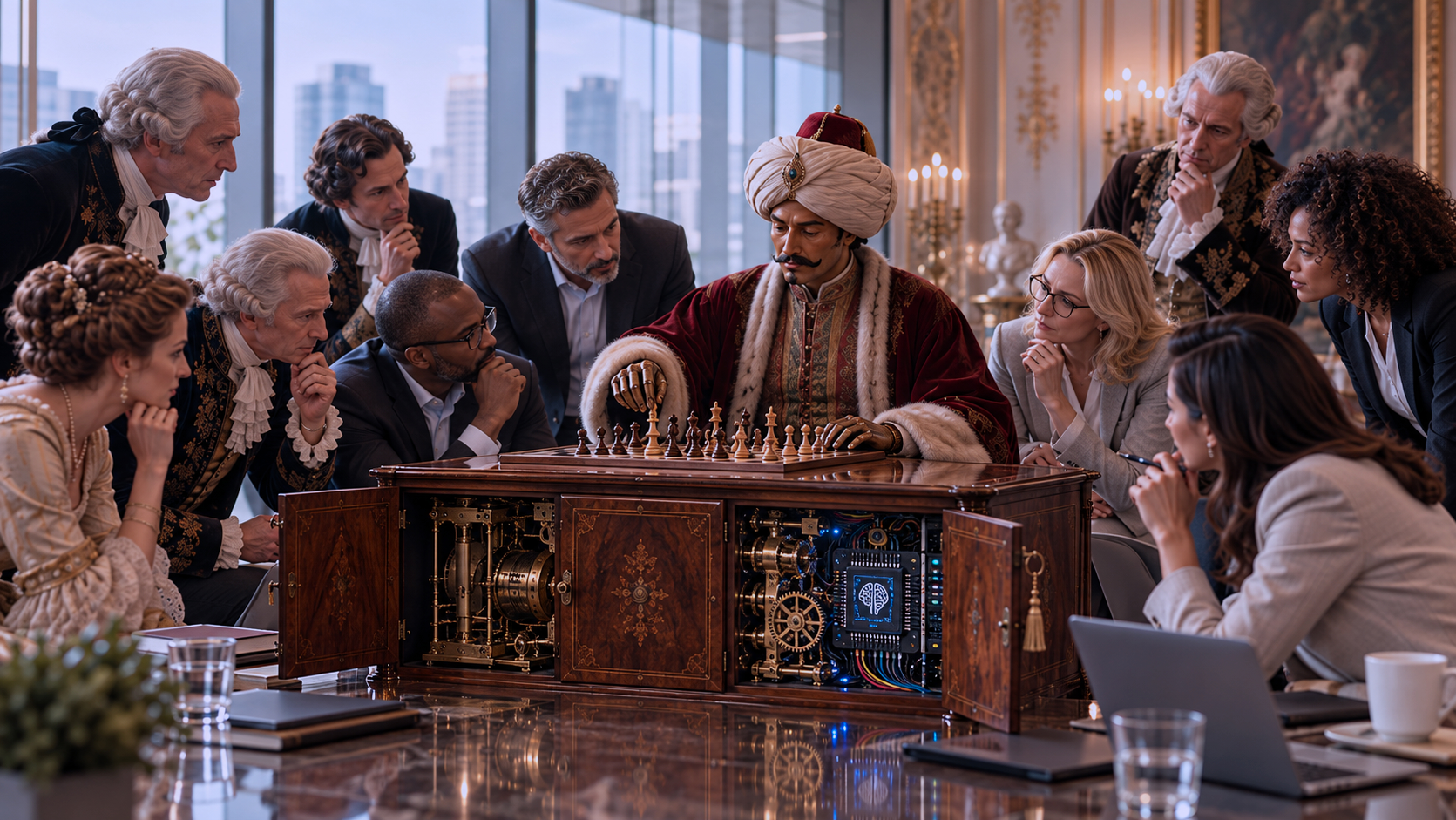
In 1770, the court of Austrian Empress Maria Theresa was introduced to an astonishing sight: a mechanical figure seated behind a maplewood cabinet that could play, and consistently win, games of competitive chess. Constructed by the inventor Wolfgang von Kempelen, the automaton was known as The Mechanical Turk. It moved its carved arm with deliberate clacking gears, turned its head to survey the board, and went on to defeat some of the most celebrated minds of its era. Benjamin Franklin played it in Paris. Napoleon Bonaparte challenged it at Schönbrunn Palace. For more than half a century, scholars, engineers, and heads of state debated how a collection of brass cogs and levers could possess intellect.
The secret was simple. It was not an thinking machine at all. Concealed within the cabinet, sliding between partitions as the doors were opened for theatrical display, was a master human chess player manipulating the pieces through magnetic linkages and pantograph levers. The clockwork gears were genuine, but they were performative theater. The real magic trick was getting the world to stare in fascination at the cabinet.
As we travel deeper into the era of enterprise artificial intelligence, that centuries-old spectacle carries renewed relevance. Today, the machine is no longer an illusion. Neural architectures write, synthesize, code, forecast, diagnose, and increasingly act with autonomous agency on our behalf. The technical capability is real, verified, and compounding monthly. The modern illusion is not that a human is hidden inside the box. The modern illusion is that the box is where our primary executive attention belongs.
The Trap of the Faster Treadmill
Corporate boardrooms and executive committees spend extraordinary energy debating mechanical questions: How capable will the next frontier model become? What percentage of administrative workflows can be automated? How many hours of operational friction can we eliminate from the quarterly reporting cycle? How much faster can our teams produce content, software, and analysis?
These are understandable operational inquiries. Yet they circle around a question that executive leadership consistently avoids answering: Save time for what?
Efficiency is an instrument. It has never been a purpose. If an enterprise uses predictive models or generative agents to compress a task that once demanded forty hours into twenty, and the organization's sole institutional reflex is to pack those recovered twenty hours with twenty more hours of mechanical work, nothing of lasting human value has been unlocked. Leadership has not created freedom, clarity, or strategic capacity. It has merely manufactured a faster treadmill.
The Limits of Economic Utility
For much of the modern industrial era, management systems have encouraged organizations to equate professional value with economic usefulness. We celebrate throughput. We audit utilization rates. We reward output volume. In our corporate lexicons, living men and women are routinely described as "headcount," "capacity," or "human resources."
Artificial intelligence will inevitably force us to confront the moral and operational limits of that worldview. When synthetic tools become visibly faster and mathematically sharper than humans at the precise cognitive routines we once celebrated as the pinnacle of professional merit, what happens to our definitions of value? If a person's dignity inside an enterprise is anchored solely in their ability to process information or complete analytical routines, then every algorithmic leap diminishes that dignity.
That equation was flawed from the beginning. A newborn child produces zero economic return. An aging parent or a retired mentor may no longer contribute to operating margin or balance-sheet growth. Neither possesses an ounce less worth because of it. Their value is intrinsic, sacred, and independent of production metrics. If enterprise leaders do not anchor their organizations in that distinction now, the rise of synthetic capability will produce profound organizational alienation: teams running faster, producing more, and feeling increasingly hollowed out.
What We Do With the Time We Get Back
The most consequential leadership challenges of the coming decade will not be technical. They will be questions of judgment, courage, trust, wisdom, and stewardship. Those obligations remain entirely human, even when our computational instruments become extraordinary.
- From Capacity to Contemplation: When automated workflows return operating hours to knowledge workers, what deliberate portion of that time is protected for deep strategic thinking, synthesis, and creative problem solving rather than immediate operational backfilling?
- From Speed to Judgment: Where does rapid algorithmic acceleration introduce dangerous blind spots, and how are senior leaders strengthening human oversight to interrogate assumptions, verify data integrity, and evaluate systemic second-order risks?
- From Utilization to Presence: Does the organization treat human talent primarily as capacity to be optimized for utilization, or does executive governance actively reinvest productivity dividends into talent resilience, ethical development, and intellectual depth?
- From Output to Purpose: What enduring mission or societal outcome does this recovered capacity serve? What is the enterprise building that cannot be measured merely by quarterly velocity?
The Unyielding Constraint
There remains one unyielding constraint that no algorithmic advancement, computational scale, or automated agent can ever resolve: time. Our children still grow up in what feels like the blink of an eye. Our parents still grow older and more fragile. The colleagues and family members we cherish will not be here indefinitely. Neither will we.
When technology successfully returns an hour, a day, or months of productive capacity to an organization, the question confronting executive leadership is infinitely broader than margin expansion. The real question is: What truly deserves the recovered time?
The Mechanical Turk captivated 18th-century Europe because an entire civilization stood mesmerized, staring at the cabinet while missing the human heartbeat animating the game. As artificial intelligence grows more ubiquitous, leaders must not repeat that historical blindness. The greatest revelation of the machine age will not be what artificial systems are capable of doing. It will be what it reveals about who we are, what we steward, and what we choose to cherish.
When synthetic intelligence becomes abundant, human wisdom, presence, and purpose become our most precious assets. The leaders who shape the future will not be those who build the fastest machines, but those who possess the moral clarity to know what those machines are meant to serve.