
The Politics of Care and the Politics of Power

In many families there is an old saying: a mother’s love comforts you, while a father’s love prepares you. One tells you that you are safe; the other insists that you must grow. Both are forms of love, and both are necessary. But they do different work in the world.
Lately I’ve begun to wonder whether this distinction helps explain something about American politics, and particularly about the political experience of Black Americans.
For generations, Black communities in the United States have possessed one of the most powerful survival tools a people can have: deep communal care. When institutions failed, families and neighborhoods stepped in. When legal systems excluded us, churches, extended families, and local networks created a kind of emotional and moral infrastructure that allowed us to endure.
This nurturing force, call it maternal love, communal care, or simple human solidarity, has been a pillar of Black resilience.
But survival virtues and flourishing virtues are not always the same.
A community that has spent centuries fighting simply to survive often develops extraordinary compassion, loyalty, and mutual protection. Yet thriving in a complex modern society also requires a different set of forces: discipline, long-term institutional thinking, economic ownership, and the kind of internal accountability that pushes a community beyond endurance toward power.
One might call this the difference between a politics of care and a politics of formation.
Philosophers have long recognized this tension. Friedrich Nietzsche once warned that cultures that prioritize comfort above all else risk weakening their capacity for growth and struggle. Compassion without challenge, he argued, can eventually become stagnation. Nietzsche’s critique was not an attack on care itself, but a warning about imbalance.
Something similar can be seen in the game of chess. The queen is the most dynamic piece on the board, mobile, expansive, able to move in every direction. The king, by contrast, moves slowly and cautiously. Yet the king anchors the entire game. Without the king, the queen’s power means nothing; without the queen, the board becomes static and constrained.
“The queen is the most dynamic piece on the board, mobile, expansive, able to move in every direction. The king, by contrast, moves slowly and cautiously. Yet the king anchors the entire game. Without the king, the queen’s power means nothing; without the queen, the board becomes static and constrained.”
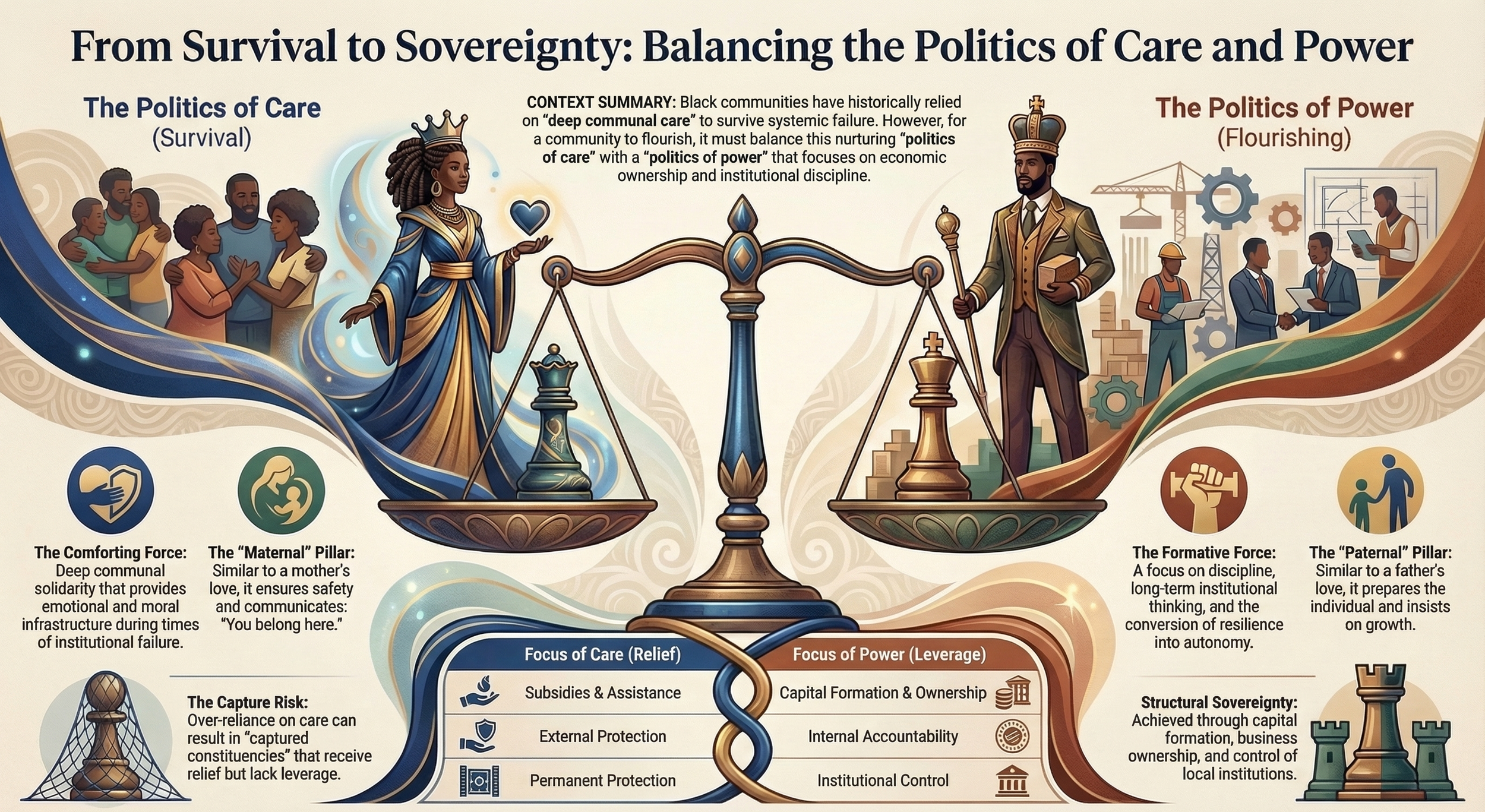
Healthy systems require both expansion and grounding.
When I look at the political relationship between Black Americans and the institutions that seek our votes, I sometimes wonder whether that balance has been lost.
For decades, Black voters have formed one of the most loyal electoral constituencies in the United States, particularly within the Democratic Party. That loyalty is rooted in real history. The Democratic coalition became the primary vehicle for civil-rights legislation during the mid-twentieth century, and many Black voters understandably aligned themselves with the party that seemed most responsive to their demands for legal equality and protection.
But political loyalty can create unintended consequences.
Political scientists sometimes describe the phenomenon of a “captured constituency”, a voting bloc so reliably aligned with one party that the incentives for meaningful negotiation begin to weaken. When votes are assumed rather than earned, the political relationship subtly changes. The question becomes not “How do we empower this community?” but “How do we maintain its support?”
In such conditions, the policies offered often emphasize relief rather than power: subsidies instead of capital formation, assistance instead of ownership, protection instead of institutional control.
These policies may alleviate suffering, and many have been morally necessary, but they rarely transform a community’s structural position within society.
The result can be a form of political paternalism disguised as compassion.
To be clear, this dynamic is not unique to Black Americans. Political systems throughout history have managed groups through a mixture of benefits and dependency. Labor blocs, rural regions, and immigrant communities have all experienced versions of this relationship. But the historical trauma and economic exclusion faced by Black Americans have made the pattern particularly visible.
The deeper question is not which party is responsible. Political parties are not moral actors; they respond to incentives.
The real question is whether Black political engagement has too often been framed primarily through the language of protection rather than the language of power.
Protection is necessary. But protection alone cannot create thriving communities.
Thriving requires leverage: ownership of businesses, control of local institutions, excellence in education, networks of mentorship, and the cultivation of leadership that demands accountability both internally and externally. These are the forces that convert resilience into autonomy.
Throughout Black intellectual history, many thinkers have wrestled with this transition. Booker T. Washington emphasized economic independence and institution-building. W. E. B. Du Bois called for the cultivation of leadership capable of guiding the race. Malcolm X warned repeatedly about the dangers of political dependency. Even Martin Luther King Jr., often remembered primarily as a moral visionary, increasingly spoke toward the end of his life about economic restructuring and the need for real material power.
Different strategies, same underlying concern: how does a people move from survival to sovereignty?
The answer may lie not only in national politics but within communities themselves.
Cultures, like families, require both nurturing love and formative love. One says: you belong here, no matter what. The other says: because you belong here, we expect more from you.
“One says: you belong here, no matter what. The other says: because you belong here, we expect more from you.”
A culture that forgets the first becomes harsh and brittle. But a culture that forgets the second risks drifting into a permanent posture of protection, waiting for external systems to provide what internal structures might otherwise build.
In chess, the queen may dominate the board, but the king defines the stakes. Without an anchor, even the most dynamic piece cannot win the game.
Perhaps the future of Black political power depends on rediscovering that balance: preserving the profound culture of care that has sustained the community for generations, while rebuilding the structures of discipline, ownership, and institutional authority that turn survival into flourishing.
Love that comforts is essential.
But love that prepares is indispensable.